
Showing posts with label Primary progressive aphasia. Show all posts

26 January 2014

Even so...

I don't know when I will once again be able to start some regular posts here - or some writing elsewhere. My energy at the moment is totally occupied in creating some new kind of order - one that will get me through this interval of time between Allen's presence in my life and the acceptance of his absence. But I want to hold on to some of the thoughts I've had during this period. And as these are often framed in letters to friends and family, I will copy to my blog excerpts from some of these from time to time. I hope later on to be able to come back to these thoughts with less pain and more pleasure in remembering my late husband....

Dear Malcolm,

I was again in tears – reading your lovely words, which I will ask Julian to read at our lunch next Sunday. Thank you so much for taking the time. And thank you, too, for capturing so well the spirit of the man I fell in love with 35 years ago.

So much of Allen’s lively enthusiasm, wit and intelligence was severely taxed in recent years by the dreadful disease eating away at that beautiful brain. Even so, right up to his last days at the beginning of what was supposed to be a short few weeks of (my) respite, he could appreciate the humour in some of the antics of fellow residents in the dementia unit. Watching a guy do something silly at a nearby table while I helped Allen to get a slippery omelette into his mouth, he looked at the guy and then over at me and raised a quizzical eyebrow, as if to say: “Get a load of him!”

Except in short episodes of delusion, mainly in the evenings or during the night, Allen and I never lost the ability to connect – even as words and language lost almost all meaning for him. He was taken to hospital after just his third night in that respite facility, when he apparently ingested vomit while lying in his bed. In all our years together, I can’t remember Allen ever vomiting – even when in hospital. So it will always be a great mystery to me what actually happened. But I know when I arrived there in the morning, and sat with him while we awaited the ambulance, he was already on oxygen and struggling to draw breath. Less mysterious is the fact that he just could not rally during the next four days in hospital, but continued to deteriorate with a terrible pneumonia.

I knew only too well that Allen had been wanting for months to be finished with his struggle. He could no longer manage to read anything but the occasional word, couldn’t write words or even letters and could only barely understand the grammar of even the simplest of spoken utterances. He was so very isolated, and his physical mobility had been likewise impaired. He just couldn’t control the voluntary and involuntary actions of many of his muscles. Each morning while I shaved him, for example, his right hand would perform a kind of pretend-shaving, and I’m not sure he understood which of us was actually holding the razor. He could only shuffle along on his walker – but always insisted on accompanying me to the shopping centre, sometimes waiting on a couch near Woollies if he didn’t feel up to the whole supermarket slog. But when we got home, he never failed to help unpack the bags and put whatever things away he could manage. He just wasn’t one to sit idly doing nothing. And yet he was losing interest even in listening to or watching the many opera DVDs that Chris had sent him from China. He felt all his forces – both physical and mental – slowly evaporating. And he just hated it.

I don’t think he had the will to fight one more battle with pneumonia – and he’d had several. And four days of IV antibiotics had done nothing to reduce the infection. He had to be on IV hydration, too, as he could no longer swallow anything. So it was a relatively easy decision to accept the doctor’s offer to begin morphine – ostensibly to minimise the pain of his difficult breathing. But we all knew what it meant. I had no hesitation in telling the doctor: “Let him go”. Allen was to all intents and purposes unconscious in the last 24 hours or so before that, but I think even he knew this was his chance to slip away. And instead of the two or three days we’d been warned it might take, Allen was gone in just a couple of hours, peacefully drawing his last breath in a lovely corner room with tea-trees and a bright blue sky outside our window. I long ago had to come to terms with the Allen I knew and loved no longer being available to me. But I’m still coming to terms with Allen not being in the next room, dozing peacefully in his favourite armchair. It’s going to take a long time. I’m glad his battle is over. Even so.....

05 December 2013

Roland Allen Harvey 1929-2013


On 18 November 2013 my beautiful husband, Roland Allen Harvey, passed away at Noosa Hospital after a brief battle with pneumonia. His physical and mental health had both deteriorated greatly in the past six months, and though we, his family, have very heavy hearts, we know his passing now, while he still knew and loved us all, was a blessing for him. It is less so for us. 

Allen's poor damaged brain has gone to the Queensland Brain Bank at the University of Queensland. We hope in some small way it will help researchers there to learn a bit more about Primary Progressive Aphasia, the debilitating brain deterioration that ultimately robbed him of his mental fluency and physical agility. 

Allen was cremated in Noosa at 8am on Friday, 22 November. At that exact time, his family gathered at The Spit, where the Noosa River flows into the sea, to remember him with a champagne breakfast.


On 15 December friends and family will gather at a lunch in Doonan to share reminiscences of my dear husband's long, productive and very happy life. 


02 May 2013

Early introduction to Planet Aphasia

Ask me what is the most dazzling theatre experience I have ever had and I will answer without a moment's hesitation that it was the 1993 premiere production of L'homme qui... at the fabulously renovated old Paris theatre, Theatre des Bouffes du Nord.

This stunning drama, inspired by Oliver Sacks' The Man Who Mistook his Wife for a Hat, was the work of British director Peter Brook and his renowned troupe of actors, dancers and musicians known as the International Centre for Theatre Research. Brook's multinational company had had a peripatetic existence until the troupe took up residence at this Paris theatre, built in 1876 and renovated in 1974 under the direction of Brook and his partner Micheline Rozan. The theatre, and the unusual way in which it was brought back to life in a way that maintained its aura as a living relic, is worth a story of its own. The Theatre des Bouffes du Nord featured prominently as a location for the classic French thriller, Diva. And if you read French, have a look at the theatre's official website for an overview of its amazing history and restoration.


We arrived early at the theatre that night, as we weren't sure how difficult it would be to find. (We'd been told it was behind the Gare du Nord, one of Paris's larger railway stations.) And we also knew that Brook's policy did not allow numbered or reserved seats. Tickets were all one price; you sat wherever you wanted, or could. It was necessary to arrive early to get a good seat. And so we had at least 15 minutes in which to sit and marvel at the incredible ambiance created by a restoration that had retained as much as possible of the fabric of more than one hundred years of use. Peeling paint on the stage's walls and overhead a giant domed grill of rusted metal contrasted sharply with crisp new seating that appeared as if suspended within the original and untouched perimeter walls.

The play itself, of course, was performed mainly in French. I say 'mainly' because a good deal of what some of Sacks' patients spoke was gibberish, in keeping with their various brain disorders. Allen doesn't speak or understand French. He knew about Sacks' work, as did I, though I don't know if either of us had yet read the book which inspired the production. But not only did Allen feel he understood most of what was going on, we both felt we could almost 'hear' what the afflicted patients were trying to say in their nominally unintelligible ramblings. All of this was due to the magnificence of the acting – there's just no other word that describes it better than 'magnificent'.

At the play's conclusion, the audience sat silent and stunned for what seemed like ages. Then applause and foot-stamping erupted (the built-up seating had a wooden floor, I think). And when the tumult finally died down, many people, like us, remained rooted to their seats. All around I could hear intense conversations in French start up about the play and its contents. It was an electrifying experience – just what good theatre should be, but so rarely is.

Why do I so often now think back to that magical Paris experience? I suppose it's because in some ways I feel I'm now living inside a Sacksian world. How strange it is that the single most inspiring theatrical experience I have ever had should so eerily have prefigured where our lives were destined to end up 20 years later – Allen struggling, mainly in vain, to make himself understood. And his shrinking brain in ever-increasing revolt against his personality and all that he once was, knew and accomplished.

It seems only appropriate to end with a statement about aphasia taken from an April 2 post on Oliver Sacks' blog:
What is aphasia?
Imagine knowing what you want to say, but your brain refuses to let you utter even the simplest word. Or imagine listening to your friends and family and having no idea what their words mean. Sometimes the ability to read or write is affected too.
That, unfortunately, is the world Allen now inhabits – a place a fellow sufferer has called "Planet Aphasia".

06 December 2012

The heat's on

It's only 90° outside this morning! That's a relief from yesterday (mid 90s) and the day before (top of 102°). But none of these temperatures is conducive to the kind of heavy slogging that my overgrown vegie patch would require if I were going to make up for a whole season of neglect.
 
In the matter of degrees Fahrenheit vs Centigrade, as in yards/feet/inches and pounds/ounces vs metres/centimetres/ and kilograms/grams, I'm ashamed to admit that mentally I still visualise the old rather than the 'modern' units of measurement. Australia converted to metric for most purposes during 1974, though the total conversion in all industries actually spanned a period of nearly 20 years due to the complexities involved in converting tools, road signs, speedometers etc. I originally migrated to Australia in 1969, before metric conversion, but was back in the USA for all of 1973. So I arrived back in Australia at the apex of the conversion timeline, and had to make that adjustment at the same time as many others. Perhaps I just consigned that one to the back burner, where it's still simmering. 
 
For 'young' readers and those my age or older who have adapted more readily to all things metric, check the thermometer and you will see that 102°F translates to about 38.9°C (and I wish I'd thought to photograph it two days ago, when that was apparently the hottest day around here since recording began sometime in the 1800s). Having to use decimals to make a point about temperature just doesn't do it for me – though wait a minute, normal body temperature to me will forever be 98.6°F, and not 37°C, as my daughter knows it. And yet, I like to think of myself as a person who can adapt to changing circumstances, someone who has moved readily among different cultures and countries in both work and friendship. Am I self-deluding in this as in other areas, perhaps?
 
Let's just agree: it's been damned hot. We do have excellent roof insulation, and get good cross-breezes up here in our hinterland location. So it's usually much pleasanter in the house than outdoors. There are ceiling fans in every room – one of the first things we did after buying this place in 1996. And ten years later, we installed good air conditioners throughout the house, too – even in my outdoor studio. I doubt we'd have invested in these if my mother hadn't been coming to live here, because we were never really worried that much about the few days every summer when temperatures rose into the mid-90s. But I'm now very grateful for the impetus that Mum's coming provided. Maybe it's age, but I'm experiencing the ennui brought on by heat much more this year than ever before. Even so, I try only to resort to aircon when the temperature is roasting. And I must admit that my reasoning has as much to do with soaring electricity costs ($200/mo. when either heat or aircon is used liberally vs. $100/mo. in off-seasons) as with ecological consciousness. 

Of course there's wonderful relief to be had in the pool. And until that 100° day earlier this week, we had been swimming every morning for the past week. It's no small effort to get Allen into his swimming togs and (safely) down to the pool terrace, then in and out of the pool when the surrounding surface is blisteringly hot and he feels every temperature variation so intently. Still, it's well worth the effort.
 

On our first swim just last week, Allen was quite literally overcome by joy, shouting out as he floated off, "Isn't this wonderful!" I think it's the freedom of movement he experiences in the water that gives him such pleasure, especially now that his mobility on land is so tentative and there's always the anxiety of falling. His balance and motor control are both very dodgy now. And though he still manages 15 minutes every morning on his exercise bike, he can no longer walk very far without succombing to exhaustion. I guess that's the result of insufficient exercise, poor circulation, age (he is, after all, 83) and, more likely, a combination of all of these plus the rampant disintegration of various areas of the brain. Everything from using a knife and fork to washing his hair in the shower requires some degree of supervision and, often, assistance. (He just can't remember that shampoo shouldn't be applied while the head is under the stream of water, or that a soapy head then needs to be rinsed.)  It's no wonder that floating freely in the pool gives him such pleasure.
 
Allen can't really swim any more – that's just one of many physical skills that he's either lost completely or that have deteriorated badly. But after experimenting with various flotation devices, even a life-jacket, we finally found a simple belted hard-foam device that supports him sufficiently, whether he's just walking in the pool or swimming' on his front or back. So now he will amble up the length of the pool in a kind of bicycle movement when on his stomach. And on his back he can manage a crude backstroke.
 
I worry what would happen if that belt buckle ever popped, and I have to remain near enough and somewhat vigilant for that reason. However, it's not far to the edge of the pool at any one spot. I think I'd manage to drag him there if I had to, in spite of never getting past intermediate level as a swimmer myself. But even though one half of our pool is very deep – even the 'shallow' end is up to my armpits, as we always planned to swim in the pool, not laze around – I couldn't possibly deny Allen the great pleasure that swimming provides just because there's a danger he might drown! He's had to accept too many losses without adding another.
 
Deciding what risks are worth taking is often an issue for carers. For example, I have a friend whose brain-damaged but physically strong husband recently decided he'd like to join a rowing club. She had to go into battle to get him in. The club was keen to take him on but their insurance company was a 'proverbial pain', said my friend. It's no surprise that insurance providers are by nature risk-averse, and this company only relented after forms were completed by doctors testifying to the fact that my friend's husband was fit enough to row with the best of them. Even then, they required that he wear a life jacket at all times. The club itself bent over backwards to help, even buying the life jacket! But my friend's husband is embarrassed that he's the only member required to wear one, and he wears a vest over the jacket to minimise his embarrassment.
 
I completely understood my friend's belief that the very small 'risk' of her husband experiencing a rare epileptic episode while rowing – possibly resulting in an accident – was more than balanced by the pleasure and sense of achievement he gets from participating in this sport. Life isn't risk-free for anyone, so why should her disabled husband be consigned to live a life of sterility! We shared a laugh about the fact that we carers must seem a pretty hard-hearted lot, in allowing our partners to take such risks. But not wrapping them in cotton wool is all part of the struggle to help our them live as 'normal' a life as possible.
_____________________
 
A postnote re safety and risk: The rubberised shoes pictured alongside the lifebelt above have been a godsend! Both Allen and I bought a pair of these years ago for walking up and down the stairs that lead to our pool terrace. That was after we had taken a tumble together on those stairs when going down the steps in slide-on sandals, me carrying all our gear and attempting to help Allen not trip over a hose lying across our path. I realised even then that slide-ons were a no-no for Allen, as his mobility had already begun to deteriorate prior to the open-heart surgery that we didn't yet realise he needed. Later, after that surgery and during Allen's long immobility and confinement to an Intensive Care Unit, I brought these shoes into the hospital when physical therapists began to get Allen up onto his feet, and he needed all the help he could get to relearn how to walk. The therapists loved these shoes, as they gave good support and grip on polished floors. Slippers were considered much too dangerous, even in hospital.

04 November 2012

Me and The New York Review of Books

For a month or so, I have been debating whether or not to renew our annual subscription to The New York Review of Books. Allen used to be devoted to this publication, and would read most issues from cover to cover. I tended to browse through each copy (dilettante that I am), picking out for closer reading just one or two articles that appealed. Sometimes, I confess, whole issues would go onto the shelf without my having even done that. At least many of the articles remain just as relevant months, even years, later. So we do have quite a collection of old editions on hand, and could probably spend a year or two revisiting these before we noticed an absence of new ones.

31 July 2012

Reality bites


The fifth annual Reality Bites festival of nonfiction literature was held last weekend here at our beautiful Cooroy Library on the Sunshine Coast. In past years I was a member of the Sunshine Hinterland Writers Centre committee that organises the festival each year, and an enthusiastic volunteer helping out at festival events. This year, however, the progression of Allen's condition made it too difficult for me to attend committee meetings, usually held in the evenings. And then when Allen was hospitalised with pneumonia in January, I had to give up any involvement in festival preparations. But as festival time rolled around, one of the women who has been a key organiser of each year's festival and who knew I'd have liked to remain involved asked if I might be able to do some of the catering for events on three successive days of the weekend festival.

27 May 2012

To socialise or not!


Yesterday we went to a neighbourhood party. The occasion was the 87th birthday of a lovely man who is something of a local icon. Like many around here, we are genuinely fond of Dudley, who is a friend to everyone and who spends his mornings eradicating weeds from surrounding bushland, as his contribution to maintaining an environment that he loves. In the afternoon he usually calls in to one or another of our houses for a bit modest socialising. He never stays long, but likes to keep in touch with us all. But the point of my post today is not how deserving Dudley is of being feted by neighbours, for he certainly is and I'm only too happy to acknowledge that. No, my point is that even though we have the highest regard for our friend, I don't think I will subject Allen, or me, to any more such parties with casual acquaintances.

Before we left home yesterday, Allen went through his various 'I have aphasia' cards and selected the one that he thought contained the best message for the occasion. He put this card in his pocket so it would be handy. And he promised me he would produce it when trying to talk to anyone, to help explain his difficulty in communicating and show that he wanted to keep trying.

We live in a friendly neighbourhood, but each house sits on one or more acres of land. This is a hinterland location and there are no footpaths. The meandering road goes up and down hills. People don't walk along our road very much, except to exercise their dog if they don't have a fenced area around their house. So we don't regularly see our neighbours, except when checking the mail or passing each other in cars. We know most of them by sight or from occasional short conversations near a mailbox. Dudley, who visits us all regularly, is something like our town crier, passing on news from house to house. But we've been here since 1996 so by now most of our neighbours know something about the fact that Allen isn't capable of independent living, that he has had a long hospitalisation and that I'm now his carer. I think a few assume he's got dementia or Alzheimer's. We aren't close enough for me to disabuse them of such ideas, but I do try to provide appropriate information whenever the opportunity arises. And for many years until her death, Dudley cared for his own spouse, who did have Alzheimer's. So he, at least, is no stranger to our situation.

Ours is probably the most modest house in the area. Houses across the street sit atop a kind of ridge which offers fabulous views up and down the coast, about 10km away. In the last 10 years most of those properties have been expanded or redeveloped and have sold for between one and three million dollars. So we aren't exactly in the same financial situation as many of our neighbours. We don't belong to local golf or tennis clubs, and we don't regularly travel interstate or internationally as many of them do. All of these things probably contribute to there being a bit of a gulf between 'us' and 'them'. But I doubt if anything contributes more to that gulf than Allen's inability to talk and socialise, and other people's inability, or unwillingness, to try and bridge that gulf.

Allen spent most of the afternoon party sitting by himself, or with me. Most guests said hello to him, and a few asked 'How are you?'. But that's as far as these conversations ever got before people moved away. Allen certainly never got the chance to show his aphasia card, explaining why he was having trouble communicating. I've never been much of a party-goer myself, but Allen was always a very sociable person and would once have been right in his element in any group of this sort. Now it's just too painful for me to watch as conversations pass him by. He can't even get pleasure from listening, because unless people take the trouble to speak slowly and clearly, he won't be able to follow the discussion. I'm not sure it's as difficult for him as it is for me to see that happen. He may be a bit more oblivious and happy to just observe the flow. I tried to question him about this afterwards, but of often happens I couldn't get a clear picture of how he felt.

We have another lunchtime party coming up in a few weeks. These midday affairs are the only kind of parties I would subject Allen to, as noisier night-time gatherings fuelled by alcohol are definitely beyond both us now. But lately even daytime gatherings can be awkward. Any talk in an environment in which several conversations are going on at once is impossible for Allen to comprehend. But this next party is a very dear old friend's family event, celebrating her daughter's impending motherhood. Our girls were born at about the same time, and we've known each other since before their births. Besides, we have a lot more in common with this family and their friends, so there's more chance of 'connecting' in incidental conversation. (I had to laugh yesterday when I heard one guest ask another: "So, you still own that shopping centre?") There may also be more willingness to be inclusive, and to try and help Allen contribute in some way.

I don't want us to end up as hermits up here on our lovely little hilltop. But sometimes one can feel lonelier in a group of people than by oneself.


24 May 2012

(Not) tasting the difference

This moussaka tasted a lot better than it looks here. When I saw lamb mince at the supermarket this week, I suddenly remembered making this dish quite often years ago. So I thought I'd give it another go. It's time-consuming: first cooking the meat sauce, next sprinkling the sliced eggplant with salt and draining it for an hour (though some newer recipes say not to bother with this) followed by quickly grilling (i.e. broiling) the slices, then thickening a white sauce and adding grated cheese and egg – and finally assembling the lot and baking for an hour.

Lately Allen and I have been eating very simple meals. Several times a week, I don't even cook but just grab something like a frozen chicken pie, baked beans or even porridge with trimmings on colder evenings. Allen seems unconcerned as long as there's something on his plate around tea-time. Though he used to enjoy good food as much as I do, now he just doesn't seem to care what he eats. And certain textures give him trouble (e.g. some cuts of meat, stringy vegetables like spinach). So easily managed foods hold more appeal than tasty dishes that are a challenge to handle or chew. Where he once appreciated and welcomed new flavours and spicy foods, now I have to give him much blander meals and add any interesting flavours to my portion only (anything hot, anything spicy etc.) The result is that I'm losing interest in cooking.

Allen couldn't remember ever eating moussaka, but he ate this whole portion. I had to cut up the slightly crusty top, as he's forgotten that knives are best used for cutting, not for pulling things apart with. I couldn't blame him too much for that, though, because my super-efficient oven does crisp up things a bit more than should happen at this temperature. However, the flavour, I thought, was exquisite: hints of nutmeg coming through the custardy topping and the eggplant and lamb such a wonderful combination. Allen's verdict, though, was less enthusiastic: "Different", was all he said when prompted for a reaction. And 'different' now is a polite way of saying 'can we not have it too often?' It's such a sad thing, this loss of good taste in food. Baked beans on toast would please him just as much, I'm sure. Maybe even more, as beans can easily be scooped up with a spoon. 

The gerontologist told me at Allen's annual check-up this year that the same part of the brain that governs speech also controls a good part of the chewing and swallowing functions. So whenever Allen has any health problems (a cold, his recent pneumonia etc.), we must immediately thicken all liquids as he's likely to ingest fluid into the lungs while trying to drink or eat. The swallowing and breathing functions are getting mixed up, it seems. I wonder if somehow this partly accounts for Allen's diminished interest in new and 'different' flavours. After all, if he's mainly concerned with 'Can I eat it OK?', he can't be too bothered about 'How does it taste?' Like so much else about this dreadful condition, the loss of good taste in food is a cruel blow.

12 March 2012

Reading and writing hurdles

Allen is working on one of the A4 sheets that the speech therapist gave him last week. This is a particularly tricky exercise for him. Sample item:

Something you can cut that is not grass:_______________________

He holds up a pair of scissors and asks me "What's this called again?" I point out that the question is not asking for something you can cut 'with', but rather, somethat that can be cut. (And how grateful I am that we don't have to get through the spelling of 'scissors'!) We settle on 'paper' as a suitable answer.

This type of question is very difficult for Allen. His aphasia is now at the point where it's not only speaking and writing that he's having trouble with. Grammar and syntax are also harder and harder for him to process. The negative twist (e.g. 'not') in this series of questions requires him to make a grammatical leap that is especially challenging. In both oral or written language, Allen now does best with simple sentences in which the parts appear in a standard order (subject – verb – object). Complex and compound sentences, or sentences like the ones in this exercise which take a strange turn, are problematic for him.

Spelling, too, is proving more and more difficult – as well as writing, which has been a problem for a long time. Combine those two difficulties, and writing out a word like 'laundry' can take a long time, and several mistakes. By the time he is forming the 'd', he has forgotten what word he started out to spell – or that's how it seems. Once an excellent speller, Allen now regularly leaves out letters and makes other spelling mistakes – things he would never have done a few years ago.

Name something you drink that isn't milk:_______________________


I have no idea why Allen answered 'yogurt' to this question! Perhaps he was thinking of the smoothies I occasionally make with yoghurt. He managed to write answers to 16 of the 20 questions of this sort, but a few stumped him (e.g. "What is something hot that is not fire?" "Tell me something wood that isn't a table.") I don't know why. And the whole exercise took him well over an hour.

I'm not convinced that Allen enjoys these language exercises any more, even though he spends hours on things like this every day. And this has been going on, now, for almost three years. If there were other things he could do – such as woodwork or gardening - I think I'd suggest we throw away the pens and papers and books and just do other things that give him pleasure. But the fact is there is very little left that Allen can do to keep himself occupied. Once a first-class putterer and amateur carpenter, now he can't even bang in a nail or use a screwdriver even to just unscrew something. And he never really cared for gardening - though he was an able and willing gardener's assistant. But anything requiring strength, coordination or a steady hand is now beyond him. So working with pen and paper is about all that's left from his former life. It also happens to be that by which, I think, he has always defined himself – along with reading, and that, too, is proving a major challenge.

Large-print books reduce the amount of text Allen has to process in each line. But as with spelling, short-term memory loss is proving a real hindrance to his getting much pleasure from reading. Quite simply, he has to read so slowly that he forgets the main elements of a story by the time he goes on to the next page. Those texts that he can process are mainly the kinds of things given to primary school children. And even though he is willing to read such texts when working in the comprehension workbooks I buy from the educational supply warehouse, he doesn't really want to read about clowns, circuses and other childish topics when reading for pleasure.
Battles and Quests
Recently I stumbled upon a series of nonfiction texts by Anthony Horowitz, intended for upper primary students. Each of four books in this Legends series (Heroes and Villains, Battles and Quests, Beasts and Monsters, Death and the Underworld) features seven stories taken from mythology or fiction that are interesting enough to appeal to an adult reader. But the little books have just the right mix of type size, grammatical construction and amount of text per story to make them manageable for someone with A's problems. I found the first book in the local children's library, and promptly ordered the next three titles from Booktopia. Until now, we've relied on library books but Allen now wants to annotate his texts and underline various things. It seems to help him digest the content, so we're trying out his new method with these little books. So far they are holding his interest.

Allen's obviously determined to continue reading and writing, even as everything gets harder and harder for him, and more and more frustrating for us both. Can anyone suggest any titles that might appeal to a serious, mature adult whose technical reading age is probably no higher than 10 years?

03 February 2012

A good hospital story, for a change

Two weeks ago I had to call an ambulance to take Allen to hospital. He was taken to our local hospital, suffering from pneumonia. That was the end of a difficult week in which three generations of my family came down with a nasty viral gastro bug that our grand-daughter picked up on her very first day at a childcare centre. Poor little Charlotte seemed to take the 24 hours of vomiting and diarrhoea quite in her stride. But her parents and grandparents weren't so lucky.

Allen and I had gone down to Brisbane to help make Charlotte's first week at childcare a bit easier by picking her up each day after lunch, instead of her having long days in her first week of care. But things didn't turn out as planned. She, both her parents and I successively succumbed to the dreaded lurgy. I hoped Allen would be spared (after all, he wasn't changing nappies). So I rushed him home on Day 4, when I was well enough to sit upright in the car for the hour's driving. But on Day 5 it was his turn. Still, the gastro seemed to pass without too much trauma. But he did have great difficulty dealing with vomiting. And we think perhaps he ingested something nasty into his lungs at this stage. Whatever the reason, by Day 6 he had a high fever and obvious difficulty breathing.

The less said about being in hospital with aphasia, the better - that's been my attitude in the past. But here at our local Noosa Hospital, I can happily say the hospital experience, though not exactly pleasant, was made much easier for us both by their very enlightened approach to caring for persons with any form of dementia. Allen's progressive aphasia is progressing to the extent that he is now often mildly confused at the best of times. But when he's very tired, his confusion increases. And when he's as ill as he was the first week in hospital, he really hasn't much idea at all what's going on.

As we have private insurance, he was first placed in a very spacious and pleasant private room. But by the second day there, doctors and nurses recognised that Allen couldn't manage when left alone. He could not remember how to ring for a nurse – or even, in the first days of treatment, where he was or why. So he was transferred to a 4-bed ward in the public section of the hospital. Here conditions were definitely less convivial for visitors (e.g. no spacious lounge for making cups of tea or watching the Australian Open on large-screen TV!) But that hardly mattered. The outstanding feature of this ward (and of several others like it) was that this 4-bed ward had a full-time nurse IN THE ROOM 24 hours a day. In fact, the attending nurse was not allowed to leave the room, even to walk down the hall for linen, without a substitute nurse standing in.

The level of personal care in this ward was almost the same as in an Intensive Care Unit, even though these patients' medical needs may not have required high-level clinical nursing. They did require a high level of care, however, since almost all the patients I saw come through this ward in our 10 days there were persons with some degree of dementia or delirium. Having a nurse in constant attendance meant these patients were able to be safely treated for their medical problem AND safely cared for. No one fell out of bed or wandered down the hall. Anyone needing to go to the bathroom had only to call or show some sign. Everyone got assistance with meals to whatever extent this was needed. Most importantly, in Allen's case, someone was always there to remind him what was happening, where he was, when his wife would be back and generally reassure him. If we had had this facility when Allen left Intensive Care two and a half years ago, I would not have had to spend weeks sleeping in a recliner next to his hospital bed. I don't know the extent to which all hospitals offer this service to patients with cognitive impairments but it's a question worth asking before admitting anyone with dementia for treatment, if you have a choice of hospitals.

Allen is now in a standard 2-bed room at a small rehab hospital that he knows and remembers. He's been both an in-patient and a day-patient there in recent years, and so I hope this will help him to settle in well for the week or two of rehab that he's about to receive. If he doesn't settle, then I'll bring him home and just take him in for regular physiotherapy. But the fact we've managed to come this far is due to good nursing geared to the needs of a very special group of patients.

18 August 2011

Aphasia Music Video

Check out this aphasia music video by Marc Black, with animation by Buzzco.


02 June 2011

Another round of therapy ends

Tuesday dawned bright and sunny up here on the Sunshine Coast, and we could happily have sat out in the late autumn sunshine for the rest of the day.


But just minutes after taking this photo, we were off to Brisbane for the last of 12 sessions in a semester-long Aphasia Clinic at the School of Health and Rehabilitation Sciences, University of Queensland. This is the third time that we've participated in this clinic – we did our first UQ clinic in 2009, not long after Allen's release from hospital, and we went again for one semester in 2010.
Each clinic group contains six or seven participants who have some form of aphasia – most of whom acquired the condition as a result of stroke. Almost all the participants come along with a family member (usually a spouse, but sometimes a son or daughter). Each week's session includes one hour of group therapy activities, and one hour of individual therapy. Here small groups of participants have to rearrange a series of pages, each of which contains text and a photo, into a logical sequence to make a story. This demonstrates clearly that aphasia therapy is about much more than just speech. The full spectrum of mental processes can be affected by the deterioration in areas of the brain that affects a person's ability to use language. Sequencing difficulties are just one of many other problems that people with aphasia may experience.

The UQ clinic program is conducted by Undergraduate Speech Pathology students working under the supervision of a Speech Pathologist from the teaching faculty. The moderate cost of $200 per clinic, or just over $8 per hour, is exceptional value for speech pathology sessions. And the group environment is particularly good for building confidence.

As well as developing and delivering Allen's individual therapy sessions, Dana and Caitlin, the two students assigned to us, administered standard speech pathology tests to Allen over the 12 weeks: the Boston Naming Test and two subtests of the Psycholinguistic Assessments of Language Processing in Aphasia (PALPA): subtests 47 (Spoken Word-Picture matching) and 48 (Written Word-Picture Matching).

Testing is worked into therapy sessions in a relaxed and friendly manner, so Allen's performance was not adversely affected by any anxiety about the process. Then at the final session, Dana and Caitlin presented us with a comprehensive 6-page report summarising Allen's test results, and comparing these to results from previous years. The report also documents his progress on therapy goals we had set for these sessions, and gives recommendations for future therapy.

Allen's poor score on naming simple objects (19/60) confirmed that he has severe word-finding difficulties. This result is down from 29/60 in 2009 and 39/60 in 2006, when he was first diagnosed (55 is considered an average score). However, when he doesn't have to name an object himself, but simply has to match a given word to a picture, or vice versa, he scores almost perfectly (37/40 and 39/40). This confirms that his comprehension of words is relatively intact – as we know from the fact that he is still an avid reader. (Currently he's re-reading Dickens and recently finished a couple of Bill Bryson's travel books.)

In past years, when we have presented a copy of the UQ report about Allen's progress to the gerontologist who treats him for aphasia, and who administers his own tests once a year, he has been very impressed with the quality of the UQ reports, and the depth of coverage. We, too, have been well pleased with all three of the UQ Aphasia Clinics we attended over three years. And I would certainly encourage anyone with aphasia to participate (the Speech Pathology Clinic webpage gives contact details – but remember to specify that you're interested in the Aphasia Clinic, which is not specifically listed on the website).

In spite of this, I think we may not be participating in further clinics. I tried to explain my reasons for this in an email to our student therapists, part of which read as follows:

I’m not sure how much Allen can profit from continued therapy that ‘challenges’ him. Whereas this used to have a good effect on him, when he was able to feel he could make progress, I’m afraid now he mainly gets frustrated by what he can’t do. His intelligence is not affected – so he knows how badly he’s performing on some therapy tasks. And sometimes this depresses him. I’m not saying this has happened too much this semester. But I have noticed a difference in his reaction to therapy.

I am inclined to think that it’s better for us to organise more social occasions – visits with friends, going out to see plays and such – than to take part in too much therapy. The truth is that Allen isn’t going to improve; he is only going to deteriorate – that’s the unfortunate nature of Primary Progressive Aphasia. But luckily, Allen is highly motivated and undertakes quite a lot of mental activity at home – he routinely works on his daily word-finding puzzle (seeing how many words he can make from a given set of 9 letters) and inevitably scoring very well) and on various other pen-and-pencil activities, plus he does lots of reading every day. So I think it’s best for him to continue that kind of activity – plus our two-times-monthly sessions with members of our own Sunshine Coast Aphasia Group – and perhaps undertake more physical activity, maybe even another round of physiotherapy.
I think a more relaxed lifestyle may be better for Allen than having to work on set tasks, or homework, that he tends to worry about finishing. And that’s why I’ve decided it’s best for us not to continue with clinics – especially since the distance we have to travel is quite a strain on both of us. It’s been a very good experience for both of us, but I think the time has come for us to be a bit more relaxed in how we deal with Allen’s aphasia.

God knows I’ve pushed Allen very hard for the past few years, and in many ways that has benefited him. But I think the time has come when we should go along at a more relaxed pace, and enjoy life without pressuring Allen too much to try and perform at a level that is difficult for him. Does that make sense to you? We’ve lived with this situation for quite a few years now, and I guess in some ways we are both rather tired of the hard work. So I guess I need a break as much as he does. Maybe by next year I’ll feel differently, but for now I think more time in the sun and less on the road is the way to go.

25 January 2011

Family fun in the sun

A couple of photos today is all I have time for. Too busy enjoying this exquisite post-deluge sunshine. Allen and I have just come in from a long, luxurious swimming session.


Allen wears a yellow flotation device around his chest. This provides enough buoyancy for him to feel confident going up and down the pool in either a dog paddle or crude back stroke. He's never in the water alone, but without the belt he has a hard time staying upright even at the shallow end. (In our pool, even here at the shallow end, where Allen's standing, the water is chest-deep. We built this pool for swimming, not wading. So the 'deep' end is exactly that: more than two metres deep.)

Allen's balance is poor at the best of times, even on dry land. So when standing chest-deep in water he can't manage even to stand upright unless he has the support of his flotation belt. But with it on, he's quite fearless and gets a lot of good exercise at every session. He used to be a good swimmer once, but swimming is another one of many abilities he has totally lost since his post-operative confinement. Funny what skills have deserted him. For example, he can no longer 'read' an analog clockface. He can recognise that it's time for the news, or nearly mealtime. But he just can't translate the clockface into words – doesn't recognise that the small hand on 10 and the big hand on 5 means 25 minutes past 10. And this is not because he can't find the words; he just doesn't 'read' clock-language any more. Solution: we bought him a digital watch. Problem solved.

And here's another photo I took just a few days ago, when we had a very pleasurable day here with Allen's niece Helen and her husband Bill. Helen and Bill were holidaying down on the Gold Coast and drove up to spend the day with us. Helen is one of two daughters of Allen's late sister, his only sibling, who was much older than him. They had good fun going through some of Allen's old scrapbooks. At one stage we heard a hoot coming from Allen's office, when Helen came across a photo of her grandfather's old ute.

"We used to all go to the beach in that car when I was a kid", she said.

In those days no one worried about carrying a bunch of small kids in the back of a ute.

It was a lovely, relaxed day. Bill and I cooked shish kebabs and marinated chicken on the BBQ. And just as we were about to serve blueberry pie, a couple of friends dropped in and joined the party.

Allen, battling his own afflictions, and Helen, valiantly fighting MS for many years, obviously share the same gutsy and fun-loving genes.

06 December 2010

PPA and hospitalisation

I've written about this before (see Aphasia sufferers: Avoid hospital, if possible!). But something – I don't know what – has prompted me to summarise it here again.

My husband, Allen, was diagnosed with PPA in 2006. Annual scans since then show that the left side of his brain is deteriorating at a modest rate. And his communication competence has deteriorated accordingly. Even so, the extensive regime that he follows of various self-designed therapies of intellectual activity appear to be paying off, according to the gerontologist who treats him. And last month's annual visit to the specialist, following this year's nuclear scans, resulted in a big 'thumbs up': "You've made my day", was the gerontologist's summary. It might well have been otherwise, however.

In 2009, Allen required open-heart surgery to repair badly malfunctioning heart valves. The heavy sedation required for that invasive surgery, perhaps made worse by many hours on a heart-lung machine, had a catastrophic effect on Allen’s compromised brain. He experienced serious post-surgical complications. Initially, Allen did not wake for several days after surgery. When he did finally regain consciousness, he experienced epileptic-type fits. So additional medication was used to control those reactions, and this resulted in more days of virtual inertia and serious breathing problems. A tracheotomy had to be performed so Allen could be intubated, and a Pacemaker was inserted a few days later. After five weeks, further surgery was required when his original wound became infected and the surgical reconnections of the breastbone unravelled.

In all, Allen was nine weeks in Intensive Care, a further two weeks in hospital, and two more weeks at a rehabilitation hospital (though access to the latter was initially denied him, in view of his inability to fully cooperate with therapists; only the intervention of our surgeon secured him a place in rehab). Throughout Allen’s hospitalisation, many of the health professionals who treated him did not appear to allow for the complications that resulted from PPA brain damage. Eventually, after the second surgery that screwed together the damaged breastbone, Allen’s treating physician did give instructions that Allen should be allowed to do things at his own pace. This meant weeks of continued inactivity under full-time supervision of an Intensive Care nurse, and no rushing Allen to ‘get up on his feet’. Even so, it was weeks before doctors and nurses agreed NOT to give Allen sleeping tablets at night, as these had a devastating effect on his consciousness for at least 24 hours afterwards. However, they would not agree to stop giving him anti-depressants and, later, anti-psychotic drugs, even though the latter produced hallucinations that continued throughout rehab, where he was gradually weaned off all mind-altering substances.

It seemed to me that Intensive Care protocols made no allowance for the effects of brain damage on other medical procedures – even though we were actually warned about this in our pre-surgical briefings! After the operation, Allen was forced to try and stand and then walk long before he was sufficiently alert to cooperate – which placed great strain on his wound and, in my opinion, may even have contributed to the detachment of surgical repairs to the breastbone. Physical therapists did not vary their routines or timetables to take account of Allen’s good and bad periods of wakefulness. If he couldn’t manage the required movements at the time allotted for his morning therapy, often because of the effects of sleep medication, he would miss out on therapy for that day. There was effectively NO speech therapy administered in hospital or rehab – other than so-called ‘swallow therapy’ to determine what type of food he should eat and to ‘test’ his level of communication. Other than good physical therapy in rehab that resulted in his being able to walk with the help of a walking frame, the only useful therapy Allen received throughout his period in hospital or rehab was what I provided during long days at his bedside, seven days a week. Had he not had a partner to do that, he would most probably now be in a wheelchair in a high-care nursing home (which, at the time of his discharge from hospital, is where his physician told me to place him!)

We know that PPA damage is progressive, and that things may continue to get worse. But hospitalisation and surgery, far from being a remedy for a PPA sufferer, may well be a ticket to a nursing home, or worse. So before you or a partner who suffers from PPA undergoes any surgical procedure, be sure to do a lot of investigating and talking around. Make sure your surgeon AND relevant hospital staff understand something about PPA and the likely effects it may have on routine medical procedures. Find out what medication is routinely used in post-surgical treatment, especially in Intensive Care wards, and what if any effects such medication may have on a compromised brain.

We were lucky in having a surgeon who was totally supportive of Allen’s needs and, most importantly, who recognised and validated my expertise in interpreting Allen’s behaviours and responses and my knowledge about PPA. Initially at least, I did not enjoy the same relationship with the other health professionals who treated Allen through long weeks of post-surgical hospitalisation. And if your partner suffers from PPA, be prepared for the fact that if you have done the minimum amount of research about PPA that caregivers usually do, then you will probably know more about the condition than anyone who treats your husband in a routine hospital environment. So you, as advocate, may well be your partner’s most important healthcare provider. And this may be a tiring and thankless job, since health professionals’ initial response to you may well be hostile. You may have to fight your way into ALL consultations about your partner’s care – including being present when ‘rounds’ are done (initially, I was locked out of the ICU ward at these times). The only medical professionals who really know and understand your partner’s needs – e.g. your family doctor (if you’re lucky), your gerontologist or other specialist – will not be accessible to you and your partner in hospital. So your partner may be treated as if he or she is demented, which is distressing. Or just as bad, information, questions and/or instructions may be directed at your partner, which he or she either cannot understand or remember, and which he or she cannot tell you about, if you weren’t there at the time.

It is a battle to get best-practice treatment for a PPA sufferer in hospital. And I’m told by friends who have had a stroke or whose partner has had a stroke, that the same applies to most aphasia sufferers. So even though we who live with PPA are prepared for the fact that our lives have been turned upside down and it’s a constant battle to retain communication function, it’s an even bigger battle if you also have to undergo what might otherwise be a routine surgical procedure. Be prepared for that, be vigilant throughout the experience and then fight your way back to health afterwards, even if the medical experts give up on you.

24 October 2010

My Life in the Theatre – and Afterwards


What follows is a copy of a 'talk' that my husband, ALLEN HARVEY, gave in Sydney recently, at the National Conference of the Australian Aphasia Association. Allen had written the text over the previous two months, and rehearsed its delivery for weeks prior to the conference, which had the name: 'Beyond Words'.

Primary progressive aphasia, the condition which is slowly eating away at the part of Allen's brain that controls speech, was the subject of one strand of the Sydney conference. Allen's presentation, which was accompanied by a slide show containing 90 photos, formed an interlude between papers presented by speech therapists with a special interest in this form of aphasia. The text of Allen's talk and a selection of photos from the slide show are included in this post.

Allen read his talk from a written text, because even though he can no longer converse fluently in complete sentences, he is able to read just about anything aloud from a written text – word-perfect, in this case. Indeed, one of the conference participants congratulated Allen afterwards, saying: "Your speech was so clear that I understood you better than any other presenter at this conference!" The training of a lifetime still serves, I guess.

Here, then, is Allen's talk...
I was born with holes in my heart.


The doctor told my mother: “He will not live beyond his thirties.”

Look at me now! 81 and still going strong.


I had my first open-heart surgery in 1962. Last year, I had open-heart surgery again. The heart was fixed OK, but I had big problems after the operation.
I have Primary Progressive Aphasia, and my brain didn’t like all the drugs I had during surgery. So! I was in Intensive Care for nine weeks.
The doctor told my wife: “You’ll never take him home.”
Well, here I am again! Just stubborn, I guess.
Aphasia is a sneak. I didn’t feel anything. I never had a stroke, and I didn’t get hit in the head like some others. Actually it made me laugh when I said the wrong word, or when driving my wife asked me to turn right and I turned left. At first, I took no notice. But my wife and kids noticed.
I couldn’t remember names. I would say the wrong word and even stutter a little. This went on for some time. Eventually, we decided to see a doctor. We thought maybe I had a stroke.
 I had a brain scan, and the doctor told us: “No, not a stroke. You have Primary Progressive Aphasia. There’s no known cause. And it will probably get worse.”
Let me tell you about my life, so you will see what aphasia has meant to me.
All my life I’ve worked in the theatre. Here’s how I got started.
When I was twenty a friend asked me, would I be in a musical comedy? “We need men for the chorus”, he said. So I said: “All right”.


I went to a rehearsal and I saw a lot of people of all ages, talking and laughing. Suddenly a voice called: “Attention, please, ladies and gentlemen. I want to do the scene in the ballroom”.
I found out this man is called the producer, and he tells the actors what to do. I decided: that is what I want to do.
In the Sydney paper I found the Independent Theatre in North Sydney. It pre­sented plays and also had a Drama School. So I started doing two classes a week.

Over the next five years, I learned stage management at the Independent by watching the plays, and I learned producing by watching rehearsals.


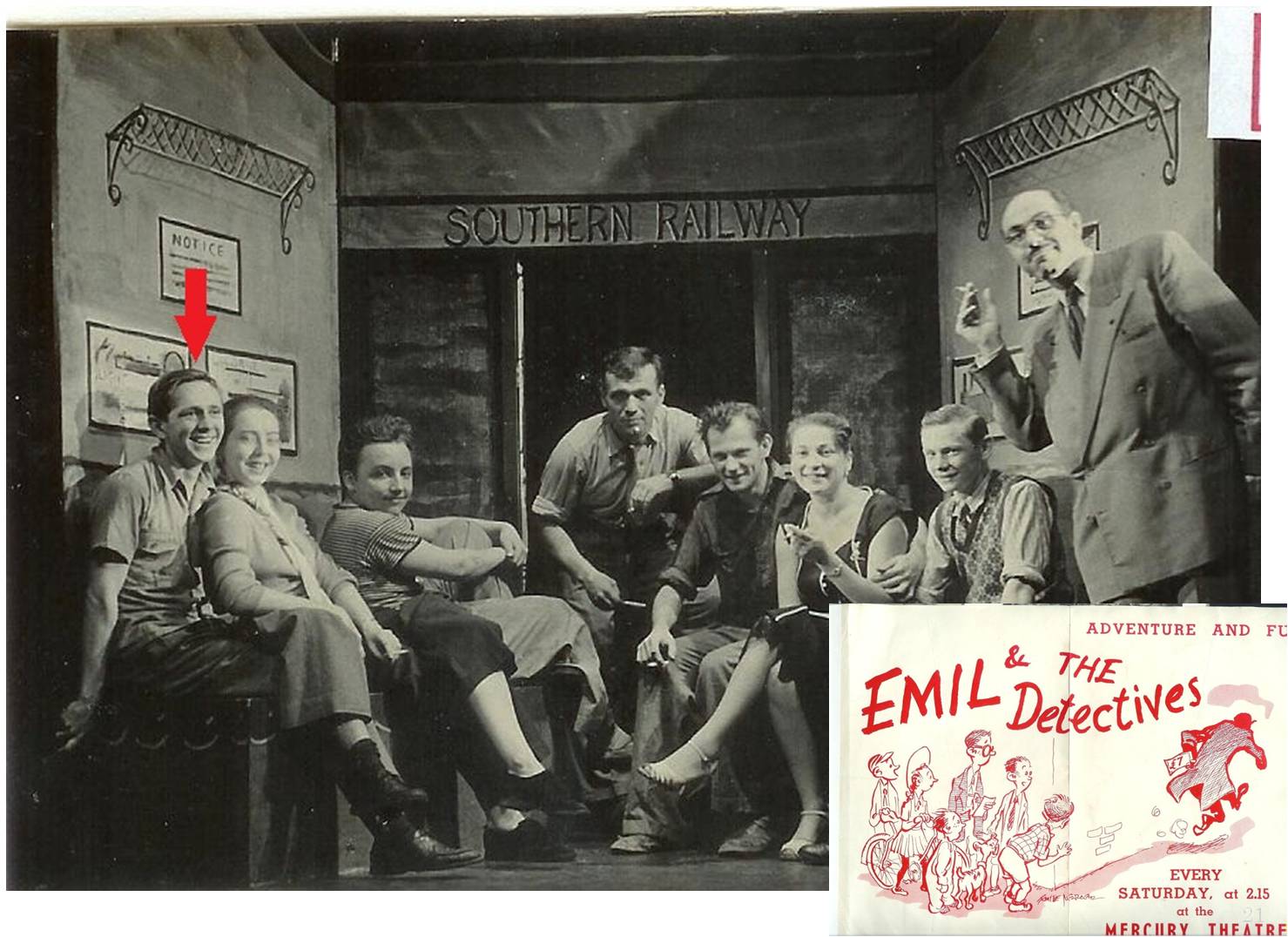
So that’s how I got started. After that, I worked six years in stage management, production and acting, in Sydney, Brisbane, Melbourne, Adelaide and Perth.


These pictures show a few of the shows I worked on.


I also did tours to country towns...


...and several tours of New Zealand


In 1960, Canberra Repertory asked me to be their Manager and Producer. I said yes. With my wife Meril (Grace) and sons Julian and Andrew, I was in Canberra for four years.


Next, the Elizabethan Theatre Trust and the British Council gave me a scholarship to study acting and production in the UK for one year. And the French and German embassies added some money.

And so I visited drama companies and saw plays, operas and musical comedies in England, Germany, Italy and France – one hundred and twenty-nine different productions. On my way home, I saw twenty more plays in New York and Canada.


Back in Australia, the Theatre Trust made me production director of the Theatre Royal in Hobart. During two years there, I produced about fifteen plays, one opera and two musical comedies.


Next I went as director to the National Theatre of Perth, and after that back to Canberra for a while.


Through someone I met in Canberra, I was invited to Hawaii to open a new theatre for the Bishop Museum. I stayed two years in Hawaii, producing plays, exhibits, dances and songs – all relating to Hawaiian history. I also wrote, produced and acted in a play about Robert Louis Stevenson, who came to Hawaii many times.


Back  in Australia I moved into arts administration, first at the Australia Council and then as Executive Officer of the Tasmanian Arts Advisory Board.

Then I wrote two plays – one for the ABC and one for a theatre-in-education company. I also wrote dozens of radio and TV scripts for ABC education.
And I wrote and produced a series of musical revues.

In Tasmania in the late 70s I also met my current wife. Carol and I have been together for more than 30 years.

  Our family includes my sons Chris and Julian, daughter Zoe and three grandchildren.
Son Julian marries Teri in September 2009
  
Daughter Zoe marries Brandon in July 2009
Another son, Andrew, died in a motorbike accident. 
Julian & Chris at my 80th birthday
Andrew Harvey 1959-1968


When I finally retired in 1996, I had been a director, stage manager or actor on one hundred and sixty different productions.
 

For the next 10 years Carol and I lived and travelled in developing countries, where she worked on aid projects.
We lived in the Philippines and Laos, and we stayed in Vietnam and Cambodia. We would visit villages and schools. Carol says I was like Prince Philip. I would walk behind her with my hands behind my back, and chat with everyone. 

Now I have a new job: dealing with aphasia! I’ve had speech therapy several times. I had two semesters at a University clinic for people with aphasia.  
This year, Carol and I took part in an aphasia clinic on the Sunshine Coast for eight weeks. The seven couples from that clinic have now formed the Sunshine Coast Aphasia Group. We meet two times a month for conversation and activities.
At home, I spend my time writing memoires and letters, reading, doing word puzzles and computer programs for aphasia, and singing every day.

Sam helps Granpa Allen with his speech therapy homework

I also try to keep active. I go to rehab twice a week for exercise and therapy.


And I help Carol in the garden.

Well, that’s my life so far. I’ve gone well past thirty. Wouldn’t my mother be surprised!


About me

My photo
Journalist, editor, teacher, publishing manager, education consultant….but that’s all in the past. Even further back, I could add waitress, Five-and-Dime salesgirl and my favourite title: Girl Friday! All mixed in with wife, mother, caregiver and grandmother. But nowadays, based on time spent: gardener, cook, reader, writer and whatever!