24 October 2010

My Life in the Theatre – and Afterwards


What follows is a copy of a 'talk' that my husband, ALLEN HARVEY, gave in Sydney recently, at the National Conference of the Australian Aphasia Association. Allen had written the text over the previous two months, and rehearsed its delivery for weeks prior to the conference, which had the name: 'Beyond Words'.

Primary progressive aphasia, the condition which is slowly eating away at the part of Allen's brain that controls speech, was the subject of one strand of the Sydney conference. Allen's presentation, which was accompanied by a slide show containing 90 photos, formed an interlude between papers presented by speech therapists with a special interest in this form of aphasia. The text of Allen's talk and a selection of photos from the slide show are included in this post.

Allen read his talk from a written text, because even though he can no longer converse fluently in complete sentences, he is able to read just about anything aloud from a written text – word-perfect, in this case. Indeed, one of the conference participants congratulated Allen afterwards, saying: "Your speech was so clear that I understood you better than any other presenter at this conference!" The training of a lifetime still serves, I guess.

Here, then, is Allen's talk...
I was born with holes in my heart.


The doctor told my mother: “He will not live beyond his thirties.”

Look at me now! 81 and still going strong.


I had my first open-heart surgery in 1962. Last year, I had open-heart surgery again. The heart was fixed OK, but I had big problems after the operation.
I have Primary Progressive Aphasia, and my brain didn’t like all the drugs I had during surgery. So! I was in Intensive Care for nine weeks.
The doctor told my wife: “You’ll never take him home.”
Well, here I am again! Just stubborn, I guess.
Aphasia is a sneak. I didn’t feel anything. I never had a stroke, and I didn’t get hit in the head like some others. Actually it made me laugh when I said the wrong word, or when driving my wife asked me to turn right and I turned left. At first, I took no notice. But my wife and kids noticed.
I couldn’t remember names. I would say the wrong word and even stutter a little. This went on for some time. Eventually, we decided to see a doctor. We thought maybe I had a stroke.
 I had a brain scan, and the doctor told us: “No, not a stroke. You have Primary Progressive Aphasia. There’s no known cause. And it will probably get worse.”
Let me tell you about my life, so you will see what aphasia has meant to me.
All my life I’ve worked in the theatre. Here’s how I got started.
When I was twenty a friend asked me, would I be in a musical comedy? “We need men for the chorus”, he said. So I said: “All right”.


I went to a rehearsal and I saw a lot of people of all ages, talking and laughing. Suddenly a voice called: “Attention, please, ladies and gentlemen. I want to do the scene in the ballroom”.
I found out this man is called the producer, and he tells the actors what to do. I decided: that is what I want to do.
In the Sydney paper I found the Independent Theatre in North Sydney. It pre­sented plays and also had a Drama School. So I started doing two classes a week.

Over the next five years, I learned stage management at the Independent by watching the plays, and I learned producing by watching rehearsals.


So that’s how I got started. After that, I worked six years in stage management, production and acting, in Sydney, Brisbane, Melbourne, Adelaide and Perth.


These pictures show a few of the shows I worked on.
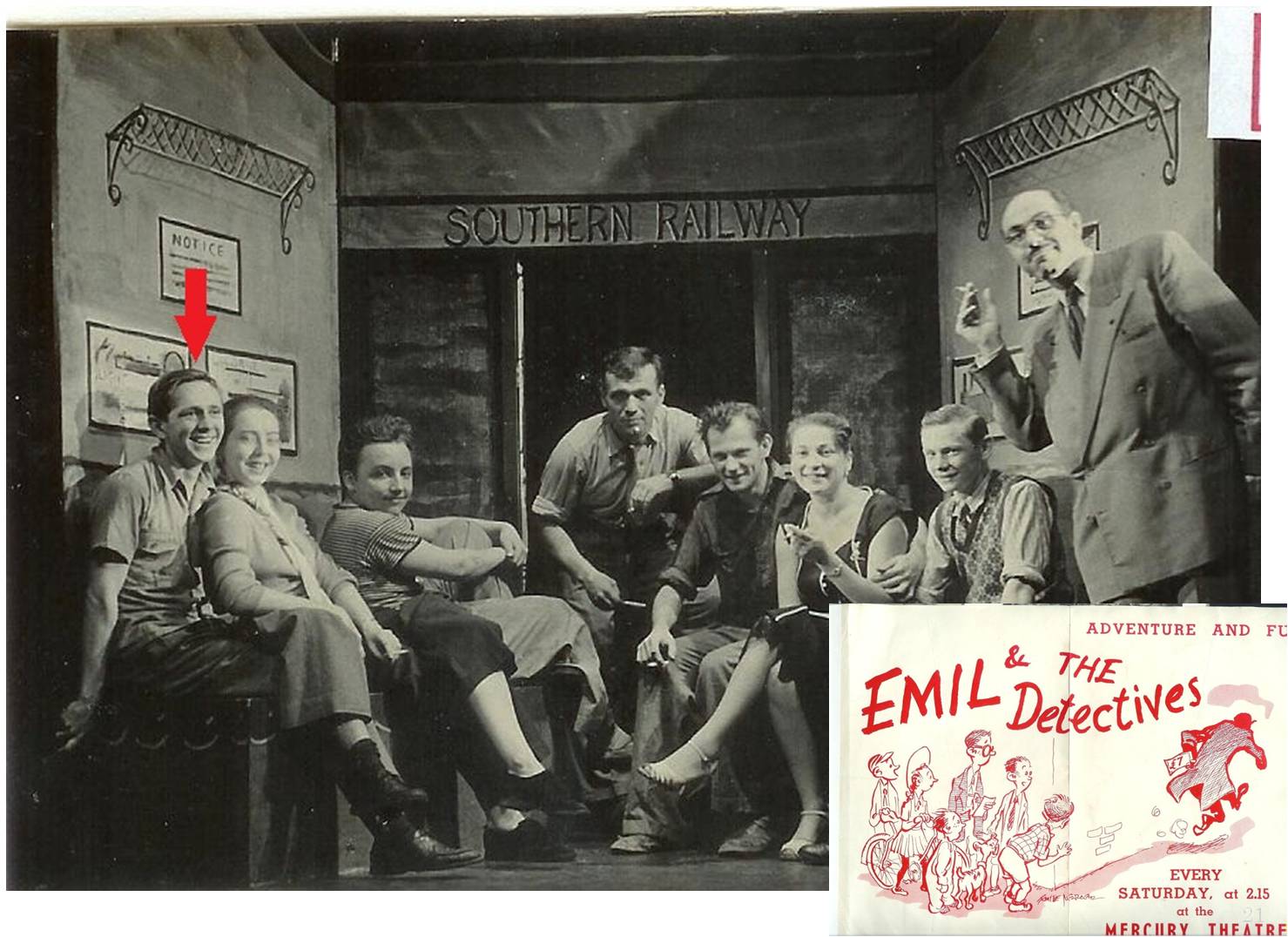


I also did tours to country towns...


...and several tours of New Zealand


In 1960, Canberra Repertory asked me to be their Manager and Producer. I said yes. With my wife Meril (Grace) and sons Julian and Andrew, I was in Canberra for four years.


Next, the Elizabethan Theatre Trust and the British Council gave me a scholarship to study acting and production in the UK for one year. And the French and German embassies added some money.

And so I visited drama companies and saw plays, operas and musical comedies in England, Germany, Italy and France – one hundred and twenty-nine different productions. On my way home, I saw twenty more plays in New York and Canada.


Back in Australia, the Theatre Trust made me production director of the Theatre Royal in Hobart. During two years there, I produced about fifteen plays, one opera and two musical comedies.


Next I went as director to the National Theatre of Perth, and after that back to Canberra for a while.


Through someone I met in Canberra, I was invited to Hawaii to open a new theatre for the Bishop Museum. I stayed two years in Hawaii, producing plays, exhibits, dances and songs – all relating to Hawaiian history. I also wrote, produced and acted in a play about Robert Louis Stevenson, who came to Hawaii many times.


Back  in Australia I moved into arts administration, first at the Australia Council and then as Executive Officer of the Tasmanian Arts Advisory Board.

Then I wrote two plays – one for the ABC and one for a theatre-in-education company. I also wrote dozens of radio and TV scripts for ABC education.
And I wrote and produced a series of musical revues.

In Tasmania in the late 70s I also met my current wife. Carol and I have been together for more than 30 years.

  Our family includes my sons Chris and Julian, daughter Zoe and three grandchildren.
Son Julian marries Teri in September 2009
  
Daughter Zoe marries Brandon in July 2009
Another son, Andrew, died in a motorbike accident. 
Julian & Chris at my 80th birthday
Andrew Harvey 1959-1968


When I finally retired in 1996, I had been a director, stage manager or actor on one hundred and sixty different productions.
 

For the next 10 years Carol and I lived and travelled in developing countries, where she worked on aid projects.
We lived in the Philippines and Laos, and we stayed in Vietnam and Cambodia. We would visit villages and schools. Carol says I was like Prince Philip. I would walk behind her with my hands behind my back, and chat with everyone. 

Now I have a new job: dealing with aphasia! I’ve had speech therapy several times. I had two semesters at a University clinic for people with aphasia.  
This year, Carol and I took part in an aphasia clinic on the Sunshine Coast for eight weeks. The seven couples from that clinic have now formed the Sunshine Coast Aphasia Group. We meet two times a month for conversation and activities.
At home, I spend my time writing memoires and letters, reading, doing word puzzles and computer programs for aphasia, and singing every day.

Sam helps Granpa Allen with his speech therapy homework

I also try to keep active. I go to rehab twice a week for exercise and therapy.


And I help Carol in the garden.

Well, that’s my life so far. I’ve gone well past thirty. Wouldn’t my mother be surprised!


01 September 2010

Ode to the first day of Spring

It's been a long time since I posted anything here. So this is a modest beginning to what I hope will be my blogging comeback! Friends have asked if anything's wrong to account for my recent silence. Quite the opposite.

We've both been doing very well. Allen's been busily engaged in a rehab program for the past three months, and this will continue for another six weeks. At home, he's working every day on his presentation for the upcoming national conference of the Australian Aphasia Association in Sydney. (We'll post that here in a few weeks, with accompanying photos.)

As for me, I've been working many hours each day in the garden, making up for almost two years when all I had time (or energy) for was borderline garden maintenance. I'll be showing the results of some of my work in future posts.

For now, here are just a couple of photos of a few highlights on the terrace and in the garden.

This beautiful orchid was a gift to me from JW. For me it's a living reminder of her late husband, our very dear and much-missed friend RW. He grew these and other orchids, so when we visited JW a few years ago on our way home from Sydney, she gave me one to take home to Qld. Since then the plant has sat in a corner of the garden, in what should be a perfect microclimate, but it has never bloomed – until now. This year the plant threw up two long flower spears, each of which has a half dozen exquisite blooms. That has to be RW wanting to share the better luck we've enjoyed in 2010.

Not far away from the orchid, two of my begonias are also blooming. (I'll try for a better picture in sunlight; this one was taken as the day was darkening.)


In the light-coloured pot between the two begonias is a ponytail palm I offered to rescue from Zoe's terrace, where it wasn't able to compete with her showier native plants! I'm not actually a great palm lover – most of those I own I inherited with the place, except for half a dozen I planted around the swimming pool. But I am rather partial to ponytails because ten years ago, when I was recovering from breast cancer, my mother sent money with my sister, who visited during my recuperation. N had instructions to buy a plant for my garden. I selected a ponytail palm, and planted it near the pool. For quite a few years it grew and developed into a fine fat specimen. Then, mysteriously, something – I think maybe termites – ate through the 'bowl' at its base and the plant collapsed and died. Now, I have another down near the pool, but I'm still partial to this little orphan.

Finally, today, my little Brazilian cherry bush (it's not big enough to be called a tree) is in full flower. I included this fruit in an earlier post (Summer bounty), where I also showed a photo of the jam we make with it, which is a great favourite of ours. This year the plant is flowering so profusely that if even a quarter of the blossoms develop into fruit, we'll be swamped.

Even from way up on the house terrace, where you look down on this area of the garden, you can clearly make out the snowy appearnace of this little beauty. The hundreds, maybe thousands, of little flowers may be individually insignificant, but en masse they turn the plant into one big powderpuff. Now let's hope that mushroom compost I've just spread underneath the canopy does its stuff. There must be a dozen bottles of Brazilian cherry jam here!

20 July 2010

Pumpkin and pastry

There is so much happening here that I have hardly been near the computer in days. Well, that's not quite true, but it is a convincing opener, right?

JW is making her annual winter visit. It's always lovely to have her company, not only because she gardens, vacuums and today, even did my ironing! No. The fact is she and her faithful pooch Lik-Lik are lovely company. We have loads of good talk, good food and the odd (i.e. daily) drop of red or white.

JW's been instructing A in using watercolours so he can add some colour to his drawings. Tomorrow we are all off to lunch, then Thursday is A's final day in the 6-week rehab program, and Friday his first art class. On the weekend, Reality Bites begins. So I guess there is quite a bit going on – even without counting my trip to the tip today with a trailer-load of prunings and then a stop at the landscape supply place on the way home to fill the trailer with hoop pine mulch. Later this week we will spread that on a section of garden that JW and I cleaned out earlier this week.

Last week while cleaning out the vegie garden we harvested the last of last year's pumpkins – three of mixed size that I found under the winter weeds. Here are two of them, in an arrangement that JW photographed as a fit subject for A's next watercolour project.

This afternoon I turned the art project into a pumpkin pie to take along tomorrow, when we have lunch with Dee, a very special Tasmanian friend who is wintering in nearby Noosa this month.

And since I was making pastry, I thought I might as well double the quantity and make a quiche for tea (see below). It was a spinach and ricotta quiche, with a few trimmings of mushrooms. But the frozen spinach more or less disintegrated during preparation, so the final result was a delicate light green in colour. Quite pretty, and tasty too. But with colouring better suited to a Christmas meal, I thought.

If this has been a very quotidian post, part of the reason is that I'm writing to stay in touch with daughter ZH, who is somewhere in Israel, attending a conference. This is her first overseas trip without hubby for company, so all the mundane news is partly for her benefit.

19 July 2010

Come meet us in Maroochydore

Seven couples here on the Sunshine Coast have got together to support each other in dealing with aphasia, a communication disorder that affects a person’s ability to use language to communicate. We're calling ourselves the Sunshine Coast Aphasia Group, and we met earlier this year when we participated in that clinic, organised by Sunshine Coast Speech Pathologists, which I've written about earlier.

Aphasia most commonly occurs as an after-effect of stroke. For five of the seven couples in our group, that is how one partner acquired aphasia – through damage to the language-generating part of the brain as a result of one or more strokes. But other events may also cause aphasia. One person had an accident which resulted in damage to that part of the brain that controls language. And of course my own husband has a rarer version – primary progressive aphasia – in which the language-generating areas of the brain begin to deteriorate for no apparent reason. Unlike with Alzheimer’s and other forms of dementia, primary progressive aphasia affects only one part of the brain. So as is the case with other aphasia sufferers, my husband has not lost his intelligence or personality. But he is greatly frustrated in his ability to express himself and must struggle endlessly to make himself understood.

Aphasia can take many forms. In my husband’s case, speaking and writing are greatly affected, but he can read quite well. As with many aphasia sufferers, he can also sing along to any song for which he has the words! But the simplest commercial transaction in a shop is a major challenge. That’s because his ability to work with numbers has also deteriorated. So even though he once managed large budgets for theatrical productions, now he has difficulty buying a newspaper, and answering the telephone requires him to read from a printed script.

Aphasia presents differently in every person, however. Some people cannot read at all; many cannot write. Not surprisingly, people who have aphasia may withdraw from contact with the world, or even from family and friends, unless they receive the right kind of support. Often they must learn to engage with the world in a new way. Hence, initiatives like the Sunshine Coast Aphasia Clinic are a godsend for aphasia sufferers, and for their carers, who have a vital role to play in helping maintain the family’s quality of life.

Our group was pretty special in that it happened to include seven couples who were all eager to make contact with others who were struggling with this affliction. For most of us, this was the first time we had the opportunity to share our stories of living with aphasia, and to learn how others cope with the daily challenges we all face. It’s very common for people who come into contact with an aphasia sufferer for the first time to assume the aphasic person is intellectually subnormal, because of the difficulty persons with aphasia may have in expressing themselves. But among ourselves, we find we can relax and have some fun with our peers without being judged.

As our eight 2-hour sessions came to an end, the group decided we would continue to meet socially once a month in a public place. Anyone who is living with aphasia would be welcome to join us. These will be social gatherings, not meetings, but the Australian Aphasia Association, which some of us have joined, will add our group to their list of regional aphasia support groups that is circulated in the organisation’s newsletter, Aphasia Link. That may help other persons with aphasia and their partners or caregivers to link up with us.

The Sunshine Coast Aphasia Group held its first coffee morning on Monday, 12 July. We had a great morning and were still lingering in the cafe's outdoor eating area at midday! If you have aphasia, or are supporting someone with aphasia, or even if you'd just like to know more about aphasia, you are welcome to join us at our monthly coffee mornings on the 2nd Monday of every month at Banjo's (Woolworths Complex, 50 Plaza Pde, Maroochydore) at 10 am. It's not necessary to book, but if you want more information you can contact me by email (chartreuse at ozemail com au). I can then give you my telephone number, if you'd like to speak to me or another member of our group before coming along.


Allen and I are pictured here with two Queensland Health speech pathologists (Cathy on the left; Ruth on the right), and other members of our new Sunshine Coast Aphasia Group, whose friendship and camaraderie A and I value greatly. (Cathy and Ruth were two of the four 'speechies' who organised and facilitated the 8-week clinic that initially brought us all together.) I have not shown faces out of respect for people's privacy. But we are continuing to meet every month, and others are welcome to join us!

If any readers would like more information about aphasia, or about our monthly social gatherings in Maroochydore, please contact me at "chartreuse at ozemail com au" (making the necessary symbol substitutions for 'at' and adding in the full stops.) I'll get back to you then with my personal contact details.

10 July 2010

A stormy winter evening

Just a few hours ago, I walked around the garden and snapped a few shots in the late afternoon light – made more dramatic by a stormy sky presaging a winter storm. And now the rain as started. So the afternoon sky wasn't lying. And once again, the tanks and pool will be overflowing in a season when we are usually using water sparingly, and thinking about topping up the pool. But here are a few things I came across in the garden today.

This poolside hibiscus (Bruceii) refuses to accept it's the end of the season. It keeps flowering and flowering. But next week when I get back down to that area to finish pruning the vegetation around the pool (I'm about halfway done that job), I'll be cutting back these 2-metre tall branches to encourage a bushier habit next summer. It's such a shame these gorgeous flowers don't survive as cut flowers. But I can at least float a few of them in a bowl of water when I chop back the plant. They're too splendid to go immediately to the compost.

Another bit of dramatic colour against the evening sky is this bougainvillea (in spite of its orange to apricot colouring, it is actually called Californian gold). I trimmed the plant recently, and most of it is securely attached to a pergola. But this shoot stubbornly pushes up toward the winter sun.

Earlier in the day I had photographed these snow white flowers of one of my favourite trees. They are ti-tree blooms, dripping with nectar. I don't know the precise variety because the tree was already here when we bought the house 15 years ago. The flowers have just opened in the last day or two. I expect we'll start to hear the humming of swarms of bees that usually gather nectar right alongside the parrots that feed high up in the tree's canopy, which you can see below.


As a matter of fact, there appears to be a beehive at the very top of the tree. I think about it every time I walk up the driveway, right under this spot. I hope it never comes crashing down!

Pink is a prominent colour in my winter garden. Many of the bushes I trimmed during the annual winter pruning are just now sending out new growth, which is often tinged pink. Below left is one of the Brazilian cherries, and in the foreground below the trimmed branches of Rhaphiolepis 'Apple Blossom' are just beginning to flower. This is not really an apple, of course – we can't grow apples or pears here – but the blooms are very like apple blossom.


Two types of produce caught my eye today. First, I picked up the last three little jap pumpkins. These had been left on the ground after I finished cutting out all the two-year-old vines that had taken over one of the vegetable beds and spread up onto the hill above, among the bananas. In the last couple of weeks we've enjoyed two more pumpkins – in a pumpkin and leek soup, in a particularly successful pie and roasted in the pan with a big leg of lamb.

 And then there are the grapefruit! They're big, they're numerous and they're almost ready! In just a few days, I'm sure, we'll be eating the first ones. This is the best crop we've ever had, and if the flavour lives up to the looks, we'll be starting our breakfasts with grapefruit for the next month or more.

Just as I was about to go back indoors, I looked up toward the western sky, where the gathering storm clouds were putting on quite a show in front of the setting sun.


To my surprise, I spotted a new home going up on the top of a hill to the west. You can hardly see it on the horizon, but what a fabulous view there would be from up there. I'll have to get my field glasses out tomorrow for a closer look.

04 July 2010

Aphasia. What a shame!

A and I have had quite a long time (about four years) to come to terms with the scourge of aphasia, and how it can blight its victims' lives. To be sure, we had even greater life-threatening medical issues to deal with one year ago. But as difficult for both of us as A's three-month hospitalisation and slow recovery from open-heart surgery were, the challenges of all that never had as damaging an effect on our relationship or our quality of life as does our ongoing battle just to be able to communicate with each other.

One reason A's inability to express himself readily in speech and writing affects us to such a degree may be that for all of our adult lives we have both placed a high premium on oral and written communication. Now, however, that critical aspect of our life together is undermined daily and in more ways than can easily be explained or imagined.

Here is just one small example. Over six weeks, A is participating in a 'Falls prevention' program at a nearby rehabilitation hospital. I drop him off there on two mornings a week, and on each of those days he has four hours of intensive therapies – physiotherapy, occupational therapy, counselling, group discussion, even basic tai chi! This is the first time in more than a year that A participates in something on his own. As I wrote in an earlier post, other than time spent with a Blue Care carer, until now A has not followed any program or taken part in any activities in which I did not participate. So this is a big breakthrough for us both.

I know A is really enjoying being part of the rehab group and 'doing his own thing'. When I pick him up four hours later, he is bursting with enthusiasm about this or that part of the day's program. But it's a good thing that he comes away with a few handouts giving some idea of the content covered that day, because all his attempts to tell me about the day's activities usually end in an exasperated groan of frustration on his part. He just cannot find the words he needs for what he wants to say or describe. And I am on tenterhooks the whole time, suspended there, trying to understand what he's desperately striving to tell me. We play 20 Questions, me interrogating and guessing, him sounding out meaningless syllables that seem to him to be related to whatever word or words he's searching for.

A can usually communicate only a small amount of whatever message he is trying to convey, and almost nothing of any subtle or humorous asides that he might like to include. And unlike for stroke victims who may improve with time, our situation is never likely to get better. In fact, it is most likely to get worse.

"Yes, aphasia is a terrible affliction. But to me, there is no shame involved, only sadness."

Far from wanting to suffer all this in private, however, I often find myself wanting to scream at anyone prepared to listen. At the very least, I'd like more people to understand something about the condition and how difficult it is to live with, especially when everything else about us may seem to the casual observer to be quite normal. I'd like people to stop telling me how great A looks, and instead spend some time trying to talk to him, or at least ask me what they can do to help. I know some people prefer to remain very private in their battle with aphasia. But for myself I just cannot understand why anyone would be worried about letting their name be used publicly when it might help to bring this debilitating condition out into the open, where others may begin to understand it.

What shame could there be in being recognised in your community as people who are dealing with aphasia? Yes, aphasia is a terrible affliction. But to me, there is no shame involved. Only sadness. But who does it help if we go on trying to deal with it behind closed doors? Mightn't it be easier to bear if more people around us understood what we are dealing with and could help? Who knows if sharing our story wouldn't help someone else who is just starting down the road and searching for ways to cope.

I know that no two experiences of aphasia are exactly alike, so I guess everyone must deal with aphasia in their own way. But some kind of acceptance, some willingness to say out loud or in print, "Yes, we have this problem, and here's what you can do to help", seems to me to be a good first step to take.

01 July 2010

Pandanus and poinsettias

My faithful friends among you will know that I'm having trouble getting back to regular posting. So this one is a bit of a cop-out. No great thoughts here. Never mind. Maybe I'll get the serious blog habit back soon. Meanwhile, here goes...

A and I are spending a good deal of time outdoors, now that (a) our weekly trips to Brisbane and Maroochydore for aphasia therapies have concluded and (b) an unseasonal spell of (relatively) cold weather appears to have passed. Even A has got into some gardening – albeit in a gentle manner. He had just finished raking all the dead leaves that fell onto this little path from an overhanging tulip tree, when he sat down to enjoy the last of the afternoon sun.

Anyone who's not from these here parts mightn't recognise the basketball-size fruit in this photo. These don't normally fall from the tree whole, like this one we cut down. Just as well, because this particular example weights 3.5 kilograms (that's just under 8 pounds). Left alone, the fruit ripens further, until it splits open while still on the tree. Then the individual segments that make up the fruit drop to the ground, one by one. This probably gives the large seeds contained in the segments a better chance of rolling away from the tree and finding a spot in which to germinate. Even so, with each fruit containing several dozen segments, and 20 or so fruit on even a small tree, that's a lot of fist-sized kernels to pick up (or trip over). Aborigines had a way of using these fruits as food, but I haven't tried them yet. They also used the long, tough, strappy leaves for all manner of woven goods (mats, baskets etc.) The tree's name? Pandanus.

My garden has about six pandanus trees in various sizes, including this large one that overhangs the pool pump house. Thankfully, I haven't yet noticed on my trees any sign of the dieback that is killing a lot of pandanus growing in areas like ours, where the cause of the disease – a North Queensland insect called the planthopper – doesn't have any natural predators.

In another part of the garden, an annual display I always look forward to is again thrilling us every afternoon, when the sun's last rays shine through the nearly transparent and spectacularly red 'bracts' (or leaves) that surround the otherwise insignificant flowers of the poinsettias. I especially love this somewhat neglected, and admittedly straggly, specimen halfway down the paddock.


Every time the flowers are finished, I debate whether or not to prune the 2 metre stems of the above plant back to some sensible size, as the gardening experts always recommend. I do that to the poinsettias growing in other parts of the garden, including some I keep in containers for a Christmas display and a few others, like this pink variety near the back verandah.

But somehow I can never bring myself to take the secaturs to that rambling specimen growing out from the base of a large old gum tree in the paddock. It's a wild and beautiful plant, reaching out from under leafy mulch on two sides of the tree, which also has a large philodendron climbing up its trunk and a few other trees and bushes alongside, making up a delightful little ecosystem. One year, a big old kangaroo often slept away his days in a nest-like cavity under all that vegetation. Well, as far as I'm concerned, that particular poinsettia can keep its long waving stems. And in return, every year it puts on a magnificent display, those nearly translucent fire-engine red bracts seeming almost suspended in the bright afternoon sunlight, or glowing rosily as in the photo above, taken just after dawn.

Most poinsettia bracts radiate around their little central flowers on a flat plane. But on some parts of my renegade plant – or maybe there are several plants growing closely together, because these flowers only appear on one side of the big tree – the bracts, like the stems, have gone a bit wild. The result is an almost dahlia-like bloom – yet another reason this poinsettia deserves to be allowed to ramble as and where it chooses. My garden has room enough for a few rebels.

19 June 2010

A kooky visitor

A few days ago, when I sat down to write Feathered visitors, about the birds that visit us regularly, I was surprised to find I had no photographs of a bird we hear almost every day, though we don't see him as often as that. That bird is the kookaburra, an Australian icon, also called the laughing kookaburra because of his curiously raucous birdsong.

Then today, just as A and I were coming up from the lower garden where we'd gone to pick a few oranges for tomorrow's breakfast juice, we were surprised to see a fat little kookaburra resting on an overhead branch quite near the back porch.

These birds don't usually hang around near the house, preferring to spend their time in the branches of the tall gum trees down in the paddock and up along the edges of the road. I think this year one family was roosting every night in the row of small bushy trees that our neighbour has planted as a hedge along the fenceline that divides our properties. I would hear them there every evening at dusk, noisily calling out the end of another day. But even when they are singing from the highest branches of gum trees across the road, we easily hear them. Theirs is not an especially beautiful song, but it is peculiar and distinctive among Australian birdsongs. And the cackle of kookaburras never fails to bring a smile to my face, sounding as it does as if the birds are having a boisterous quarrel.

A couple of years ago I had a close encounter with a very fat specimen. I was turning over the rich soil in this newly constructed vegetable patch. Sackfuls of horse manure had been spread on the new beds and left to rot over several months. And as I turned the rotted manure into the topsoil, scores of juicy big worms appeared. Not long after I started the job, I noticed a large kookaburra perched in a nearby tree, watching me, obviously uncertain whether to risk diving down for a feed of worm. I picked up a large worm and threw it onto the gravel path alongside the garden bed. The kookaburra immediately flew down and pounced on the worm. The he flew up to the sit on one of the bamboo tomato towers in the next plot. I continued turning over the bed, throwing the bird a worm now and then. He didn't catch them in mid-air, as the butcher birds do whenever I toss them scraps of leftovers. But he was quite comfortable being fed by me for nearly an hour. Don't look for the bird in this picture, though. As soon as I went up to the house to get my camera, he disappeared!

Up close, the kookaburra really is a most magnificent fellow, not as splendidly coloured as his smaller kingfisher cousins, perhaps, but thickly plumed, and as he often sits hunched over in a little ball he looks more like a child's fluffy woollen toy than a bird. He's well known as an early riser, too. Often he's the first bird to sing at the crack of dawn. In fact, if a family is nesting or roosting in a tree that has a view of our house, and for one reason or another I get up before dawn and switch on a light, the kookaburra will mistake my lit-up window as the dawn's early light. And sure enough: a short sharp chorus of kookaburra laughing will start up right after my light goes on, and stop when I turn it off. Because of that, plus the bird's slightly bizarre looks and strange guttural song, I can't help thinking of the kookaburra as being slightly dopey. Even so, he's always welcome at our place.

17 June 2010

Partners in caring

Today is a cold wet day here in Queensland. Of course, 'cold' is relative. It's about 17 degrees Centigrade (64 Fahrenheit) and there's no wind at all. So I can hear North American and Tasmanian readers snorting in derision! But it did rain last night; the gauge says 22 mm – just enough to bed down my new mulch and provide a good drink to the grapefruit and oranges that are near to ripening. But this morning it's still damp out and there's hardly any sun, which is not a typical winter day here in Paradise. So we are feeling hard done by.

Except for this: I am home ALONE for the first time since A came home from hospital this time last year. Until today, except for one four-hour session each week when a Blue Care carer has come in to spend time with A while I go off somewhere, A and I have spent every waking and sleeping hour of the year in each other's company. And I have never in all that time been home alone. It has to be a testimony to our deep affection and great friendship that A and I have managed to get through this post-operative year without any eruptions that I can recall. But much of the credit for this has to go to him – to his easy-going nature, his willingness to accept change and his refusal to give up trying to get on with all those intellectual pursuits that have made him who he is. Even when, in the first few months after his release from hospital, he could not yet get to his feet without assistance, he would spend hours every day reading, relearning how to form letters and practising his writing, singing along to favourite songs and practising his speech.

This week A began a six-week program of rehabilitation at Eden Rehabilitation Centre. He'll go twice a week, for four hours a day. He's an in-patient during these sessions, so the program is covered by our health insurance. Focussing on 'Falls Prevention', the sessions include physiotherapy, occupational therapy and various other therapies tailored to meet the needs of the four people participating (three elderly women and A!) It's about a 15-minute drive for me to take him there, and the 8am starting time is a challenge for late-risers like me – though no problem for A, who easily gets up at 6am, which is what we both need to do to be ready in time. But except for one hour once a week, I'm not expected to participate in these 12 half-day sessions. So for most of A's time there I am free to do whatever I like. Today I decided I would come back home and just be here – alone.

Solitude has always figured high on my list of indulgences. The informally negotiated terms we agreed when A and I started living together more than 30 years ago included an acceptance that neither of us would give up following individual pursuits and chasing our own dreams. For A, this meant implementing a plan he was already formulating before we linked up, to give up his secure arts administration salary and return to freelance theatre work. We made sure to get a mortgage on our first home approved before A's resignation, because at that time banks were reluctant to consider anything but the male breadwinner's salary when making decisions about mortgages. Mortgage secured, though, A quit his job in administration and resumed work in theatre and scriptwriting.

Some years later, when my career development depended on an interstate move, there was never any question that A would agree to this. His being freelance made it easier, but at his age then (58), finding new outlets for his freelance services was not easy. Ten years later, when my consultancy work meant more overseas travel, A might well have been reluctant to make more changes at a stage of life when most people are well set in their ways. But when the time came to make a decision, he enthusiastically wrapped up his professional activities and made a graceful transition to supportive house-husband.

Being 17 years older than me probably made it easier for him to give up work, but it was late in life to take on the job of running a household, especially in a developing country! Even so, A tackled that with dogged persistence and great good humour. His experiences dealing with plumbers in the Philippines, where clients were expected to buy and supply all the necessary parts for any job before work could begin, are worthy of a separate post! (In the end, the fact that our flush toilets functioned at all was due more to A's handiwork with bits of metal and plastic – and rubber bands! – than to local plumbing expertise.)

So I continued doing aid work – in the Philippines, Laos and Vietnam – and A continued to manage our domestic life. Sometimes this meant setting up house for a few months in a hotel room, with lots of negotiation about such things as better reading lights, additional pillows for reading in bed, a second desk for A! Inevitably, when the time came for departure there would be heartfelt farewells with staff, thanks mainly to A's being on such good terms with everyone. Cleaning girls would give us gifts, as well as vice versa, and we would find ourselves at weddings and other family events with the families of young hotel managers and others whom A had befriended. In one two year assignment, we never again had to stand in line at the state bank's currency exchange office after the girls working there adopted A as a surrogate grandfather.

Over the years of my various assignments, A has helped to train local scriptwriters for educational TV, helped senior secondary students in Laos to direct a film as part of their introduction to media, and made market ladies giggle in gleeful expectation every time he would alight from a tuk-tuk to shop for the week's provisions. Now, those same qualities that enabled him to deal calmly with situations that many his age (and younger) would have found trying are helping him to tackle the more stressful challenge of losing his ability to use language. He's a survivor, and perhaps most importantly, he is adaptable. Nor is he too proud to admit what he doesn't know or can't do. And he doesn't mind accepting help. All of that makes my role as caregiver so much easier.


Even so, in recent years we have both had to give up things that meant a lot to each of us. We've lost access to my good income stream a lot sooner than I had planned. A has lost his independence, self-reliance and the pleasure of participating actively in the upkeep of house and property. He can no longer take on the little building projects he once loved. And I know he worries about being a burden. I have had to give up work that I loved and the chance of a livelier retirement than I expected. But perhaps most of all for me, for much of the past year I have had to forego the occasional spells of solitude I enjoyed while travelling alone on short-term contracts, disappearing into my studio for days at a time or just being at home alone while A was out pursuing his own activities.

Now we live in each other's pocket, it seems. For both of us, that's a new, more conventional existence than what we were used to. Luckily, we seem to have got through this difficult year of transition to...well, who knows to what! One thing we've realised is that none of us knows what will come next in life. This year we have learned not to worry about that so much, and just to live in the present.

15 June 2010

Feathered visitors

It's about time I posted some photos of the birds that visit us regularly. I expected I'd have an abundance of photos to choose from, but in fact I didn't find that many really good photos in my bird file. Nevertheless, I'll use what photos I have on hand. And as I get better ones of any of these birds, I'll update this post. Maybe this will motivate me to work a bit harder at capturing better shots of some of these elusive but spectacular visitors.

Probably our most regular guests at the two bird feeders are small flocks of rainbow lorikeets. These birds are more plentiful at times when food is less abundant in the bush. I don't feed them a large amount of seed unless times are tough for them. But I have planted grevilleas and banksias near the bird feeders, and the flowers of those bushes are an even bigger attraction to the parrots than any birdseed I put out.

Slightly more exotic (at least to interstate visitors) is the pair of king parrots – Mr King (below) with his electric red head and breast positively glowing in sunlight, and Mrs King, a bit less flamboyant, perhaps, but in better light you would see that her green plumage is tinged here and there with touches of turquoise. They are a shy twosome, rarely allowing me to get near enough to take a good photo. And though they almost always visit as a pair, often one will sit in a nearby tree or bush, or on the back of a chair (as at right), while waiting for the other to feed.


Just as lovely as their showier cousins are the delicately toned pink and grey galahs. We don't get them too often, and it's probably just as well because they can get through a plate of birdseed pretty quickly. Large flocks are a menace to farmers, of course. But it's hard to think ill of anything as pretty as a pair of cooing galahs.

Speaking of menacing feeders leads quite naturally to thoughts of cockatoos. We have both the sulphur-crested white and the yellow-tailed black cockatoos at our place, though I've only seen the black ones down by the dam and never had a camera handy at the time. More common are the white fellows. They usually feed high up in my African tulip tree, whose giant seed pods they rip open and then drop from a great height. And every year they devour most of nuts on my pecan tree before I get any. But now and then one or two birds – sometimes five or six – will come down and raid the birdfeeders. Lucky they aren't aggressive. That big beak could do a lot of damage.

The last parrot I should mention is the dear little pale-headed parrot, an extremely timid visitor who comes alone or sometimes with a mate. Everything about him is delicate – colour, song and eating habits.

A family of frogmouths often used to spend the day sleeping in one of our trees. The bird gets its name, I guess, because when he opens that huge mouth, supposedly to frighten predators, he does look very much like a frog. But usually, he just sleeps the day away, posing successfully as a dead branch. It's months since we've seen a frogmouth in any of what used to be their favourite trees. But we have seen a few dead ones on nearby roads. Unfortunately their habit of eluding predators by keeping still isn't much use in the face of oncoming cars.

Not nearly in the same beauty stakes, but probably one of the most glorious songbirds hereabouts is the pied butcherbird. (Check out the songs of this and 39 other Australian birds at Birds in Backyards. The butcherbird featured there is the grey one, and our Queensland variety is black and white, but the song is the same, to my ear.)

The butcherbird is so called because of his eating habits and diet. Finding himself with a surplus of 'meat' (such as large insects or even small snakes), he will 'hang' the leftovers in a V-shaped fork of two branches, or on some protruding piece of branch or stem, ready for his next meal.

I once saw one of 'our' butcherbirds use that lethal beak to dislodge a little micro bat from a snug spot up behind one of our porch rafters, where the bat was sleeping away the day. The bird then chased the disoriented bat around the verandah for a few minutes, finally 'catching' him and flying off somewhere to enjoy this treat. Prior to this I didn't even realise these tiny bats were living up there.

I can't talk about birdsong without mentioning the inimitable eastern whipbird. We are lucky to have at least one pair of whipbirds who visit us regularly – especially after lots of rain, when they patrol the well-protected banks above and below our house several times a day. There, close plantings of various shrubs and small trees offer the protection these birds like to hunt in. But other than sticking to these shady enclaves, they are remarkably unconcerned about us coming near.

The difficulty in photographing whipbirds is that they rarely stay still for more than a few seconds. Travelling almost always in pairs, the showier male and his olive green partner bob around amongst the branches, often dropping suddenly to the ground to stir up dead leaves and mulch in search of the insects they favor. I have also seen one pair feeding on the little red berries of an asparagus fern, so they must be omnivores. They keep in touch while moving about via their hauntingly beautiful song, which is actually a duet. The first whiplike part is uttered by the male, and the two short notes at the end are the female's answer. There is also a little muttering chatter they make in between songs, which I find particularly attractive: "I'm right here", it says. "Are you still there, too?"

Another regular visitor is the large white-headed pigeon. I sometimes worry about the chains that support this birdfeeder when several of these fat beauties land there at once. Their size may have made them a target for hunters in earllier times, but they don't seem to be bullies. Often I see one or two of them waiting in overhead trees while the boisterious rainbow lorikeets eat their fill. And as soon as I approach with a camera, off they go, in a great flutter of their large wings.

I wouldn't be sad if this next visitor turned his back and abandoned our garden for good. He's the native turkey, and I'm sure he has a role to play in the Australian bush. But he's not very welcome in most backyards and gardens – even those based on native plants. And you can't see it here, but he has great big feet that can rake up a cubic metre of mulch in one afternoon, or tip over and break a big ceramic feeder. Once you've allowed a male turkey to build his massive nest in your yard, as we have, the measures you'll have to adopt to discourage him from coming back to the same place every year are all illegal.

Equally messy visitors, but somehow more acceptable, are little pairs of wood duck that adopt our back verandah every now and then for a week or two at a time. One year a pair built a nest under a bush alongside the swimming pool, but something, probably a monitor lizard, got the eggs. I try not to encourage the ducks because their bathroom manners are atrocious. But while she lived with us for a year, Mum was very fond of them. She would sit out every day with her little pot of grain, waiting for them to call by for a snack. I think they still come looking for her.


12 June 2010

Mulch good enough to eat

It's Friday and the kiddos arrive this evening for the weekend. That's always good motivation to finish up a few tidying tasks that have lingered on through the week.

First, there's half a trailer-load of 'hoop fines' mulch to be spread. It should be just enough to finish the second terrace on the northern side of the house. The top terrace contains my prolific lime tree and some gardenias as well as my faithful old rosemary. The second terrace has bird-attracting native shrubs. I've checked a few websites and it seems that with the addition of blood and bone, hoop fines should be fine around all of those.

In fact, this is not the mulch I planned to buy when I went down to Doonan Sand and Gravel last weekend. I went looking for curly hoop to top up a rather steep bank alongside the road, where I renew the mulch around my lilly pillys every year or two. Curly hoop lasts longer and keeps the weeds down OK. It also sits well on sloping sites because the pieces of bark intertwine and 'stay put'. Doonan didn't have the exact type of mulch I wanted, but a 1-inch hoop seemed OK for the same purpose (why do we persist in measuring our mulch in inches when we've been metric for 40 years?)

Unfortunately the hoop-fines bin was right alongside the bin containing 1-inch hoop. So when I went into the office and asked the lovely lady there to load up my trailer, I may have said only 'hoop'. She sent her obliging son off to do that. She and I chatted on for a while about how nice it is to have obliging children around! And by the time I got back to the trailer, it was already half full of hoop fines, not 1-inch hoop! Her obliging son and I discussed how best to start over (emptying a trailer is a lot slower than loading it!) But then I realised my level front terraces could use the extra lift provided by a richer mulch, so I bought the 'fines' after all. And I'll go back for the 1-inch hoop as soon as the trailer's empty. The mistake was as much my fault as their's, so they really needn't have given me a discount! But my! my! what a lovely mix this is: reminds me of a chocolate-coloured shredded wheat! Don't you just love much!

08 June 2010

Back on (blog) track

I'm back! Of course, I've been here all along. We both have – A and me! But we've been engaged in a furious round of medical and allied health appointments, as well as participating in two different sets of aphasia clinics, each lasting several months – one in Brisbane (therefore that's a whole day's commitment each time) and one closer to home on the Sunshine Coast. Then A began a series of weekly physiotherapy sessions at the rehab hospital where he was a patient following his hospitalisation in 2009. What with running around to all these places and helping A in the routine tasks of daily living that he hasn't been able to do without aid since he fractured his shoulder in a fall in late March, I have been just too busy to spend much time here on blogging.

We are still seeing various doctors about a problem with A's kidneys, a condition probably exacerbated by all the antibiotics that were required to save his life from that terrible post-surgical bone infection. He may need a minor surgical procedure to insert a stint into one kidney to alleviate that problem, but I'm assured this is a minor procedure, one I hope will require only local anaesthetic.

So things are getting back to 'normal', or what we've now come to accept as normal. A's shoulder bone is finally healing – though we had a big scare after two months when one doctor suggested the fracture wasn't healing and so might need some kind of surgical intervention. But a specialist bone doctor put our fears to rest, saying he could definitely see new bone forming. And now we can see evidence ourselves that the shoulder is getting better.


This morning I heard a yelp from the kitchen, where A was busy unloading the dishwasher (that in itself another sign he's getting better!) I was briefly afraid he'd done some damage or fallen again. But it turned out this was a yelp of joy, because he'd just been able for the first time since his fall to raise his arm high enough to hang up the pots from last night's dinner!

This week is the first week in months that we are able to spend almost every day at home. All we have is one doctor's appointment and one physiotherapy session. Oh, and a Film Society screening on Wednesday evening (The Eclipse). As a result, I've been able to spend the first two days of this week in the garden. From just one small section of garden bed on a terrace above the swimming pool, I've cut out a whole trailer-load of a terrible new vine-like weed that has sprung up in the past year (don't know the name, but it has awful bean-like fruits so will probably sprout again; I will need to be vigilant). A has spent the first two mornings of the week at his new pastime – drawing. We are retired, at last!


Incidentally, doesn't our new pergola look great? Can you imagine any better use of the top of a 40,000 litre rainwater tank? Now watch this space and soon you'll see a few other scenes from my newly weeded garden!

About me

My photo
Journalist, editor, teacher, publishing manager, education consultant….but that’s all in the past. Even further back, I could add waitress, Five-and-Dime salesgirl and my favourite title: Girl Friday! All mixed in with wife, mother, caregiver and grandmother. But nowadays, based on time spent: gardener, cook, reader, writer and whatever!