When we settled in for our two-year job in Laos, we had tossed up the pros and cons of apartment living vs renting a house somewhere in the suburbs. But since I was working a good 10 or more hours a day, and travelling often to remote districts to monitor project activities, we opted for as simple a daily lifestyle as possible when in town. Probably just as well, or I'm sure I'd have spent too many hours I could ill afford tending a lush garden such as those maintained by the families of our Lao friends.Will I ever again grow a lotus as lovely as this one? Bo pin yang (i.e. 'never mind'). The memory of it will always be with me.
07 December 2009
A balcony garden in Vientiane
When we settled in for our two-year job in Laos, we had tossed up the pros and cons of apartment living vs renting a house somewhere in the suburbs. But since I was working a good 10 or more hours a day, and travelling often to remote districts to monitor project activities, we opted for as simple a daily lifestyle as possible when in town. Probably just as well, or I'm sure I'd have spent too many hours I could ill afford tending a lush garden such as those maintained by the families of our Lao friends.Will I ever again grow a lotus as lovely as this one? Bo pin yang (i.e. 'never mind'). The memory of it will always be with me.
28 November 2009
Pots and pandanus
I finally decided to grub out the messy travellers palm that previously stood in this spot. And what do you know! Suddenly we have a lovely view of what is now a gigantic pandanus that towers over the pool pump house. So I've moved my little bubbling fountain-in-a-pot over to this part of the garden, and this is the view now from the back verandah, where we have breakfast when we're feeling idle. I've taken a hint from a nearby nursery and plunged a pot of vietnamese mint right into water, standing the pot on a brick inside the blue-green water bowl at right. That should keep this thirsty plant happy! Then last week I bought fairy lights, intending to string them up in the pandanus. On reflection, I don't think I dare climb up into the tree. I may use them instead on the new pergola atop the water tank. But this is a pretty little corner anyway. The pandanus appears to be growing up out of the pot in the foreground. And I'm just waiting for the candle banksia at the left to set some new yellow banksia flowers. That's Mary River gravel, in two sizes, on the ground. And now that the river isn't going to be dammed, maybe the price of gravel will come down??
Early Christmas colour
Clucky business
30 October 2009
Thursday snips and snaps
Meanwhile in the house, A's favourite Blue Care visitor had arrived and was putting him through his paces. Usually I go off to run errands and get the groceries while a carer spends four hours with A. But this week I took advantage of her visit to have those hours in the garden without having to check on A, help him do this or that, or worry about whether he's OK. Blue Care sends us a carer every Thursday for four hours, and it's a great help to both of us. But as was the case with hospital nurses, the health management folk who do these rosters seem to think it's best not to be consistent in their staff assignments. No doubt the aim is to prevent 'clients' getting too attached to individual nurses or carers, and in the Intensive Care ward where A was nearly comatose for so long this policy didn't have too many negative consequences. At least I could look forward to having the 'best' nurses caring for A as often as the less inspiring ones (and while I'm sure they were all well qualified, at least to me some made more interesting companions for the day than others; more importantly, when he was lucid A could understand some of them and not others, and only a few of them could understand his very slurry early speech attempts). But now that A is able to function so much better, it's unfortunate for him and inconvenient for me that, just as a matter of Blue Care policy, we get different carers from time to time. 'Unfortunate' because it takes time for anyone to get used to A's communication style. And it takes him quite a bit of time to be comfortable enough with a new person to communicate at his optimum level. Then, I need to spend time explaining to every new person things about A and about the house. And each new carer seems to feel the need to read A's entire Blue Care file (which is getting pretty thick). But most importantly, A gets along so well with S (our favourite carer) and so looks forward to the hours he spends with her. So it's a shame when suddenly we get sent a different person, especially one whose communication skills leave a lot to be desired. S and A have a number of favourite activities – she's happy to help him with his puzzles and games, or help him bake a cake, or take a spin around the garden with him. But she also knows just how much to help, and how much to encourage him in his independence. Most of all, she likes conversation and encourages A in his speaking and writing activities. And his communication practice really benefits when he relates so well to his carer. All of the four carers we've had to date have been good, competent professionals, I 'm sure. But S just suits A so well. It's a shame we can't be sure of always getting her. I tried having a discrete word to Blue Care about our preferences, and that seemed to go down OK. So we'll see what happens in subsequent weeks.
* D and N each deserve to be the subject of separate posts, which I may write at another time!
A's favourite Blue Care visitor had arrived and was putting him through his paces. Usually I go off to run errands and get the groceries while a carer spends four hours with A. But this week I took advantage of her visit to have some hours in the garden without having to check on A, help him do this or that, or worry about whether he's OK.
Blue Care sends us a carer every Thursday for four hours, and it's a great help to both of us. But as was the case with hospital nurses, the health management folk who do these rosters seem to think it's best not to be consistent in their staff assignments. No doubt the aim is to prevent 'clients' getting too attached to individual nurses or carers, and in the Intensive Care ward where A was nearly comatose for so long this policy didn't have too many negative consequences. At least I could look forward to having the 'best' nurses caring for A as often as the less inspiring ones (and while I'm sure they were all well qualified, at least to me some made more interesting companions for the day than others; more importantly, when he was lucid A could understand some of them and not others, and only a few of them could understand his very slurry early speech attempts).
Now that A is able to function so much better, it's unfortunate for him and inconvenient for me that, just as a matter of Blue Care policy, we get different carers from time to time. 'Unfortunate' because it takes time for anyone to get used to A's communication style. And it takes him quite a bit of time to be comfortable enough with a new person to communicate at his optimum level. Then, I need to spend time explaining to every new person things about A and about the house. And each new carer seems to feel the need to read A's entire Blue Care file (which is getting pretty thick). But most importantly, A gets along so well with S (our favourite carer) and so looks forward to the hours he spends with her. So it's a shame when suddenly we get sent a different person, especially one whose communication skills leave a lot to be desired. S and A have a number of favourite activities – she's happy to help him with his puzzles and games, or help him bake a cake, or take a spin around the garden with him. But she also knows just how much to help, and how much to encourage him in his independence. Most of all, she likes conversation and encourages A in his speaking and writing activities. And his communication practice really benefits when he relates so well to his carer. All of the four carers we've had to date have been good, competent professionals, I 'm sure. But S just suits A so well. It's a shame we can't be sure of always getting her. I tried having a discrete word to Blue Care about our preferences, and that seemed to go down OK. So we'll see what happens in subsequent weeks.
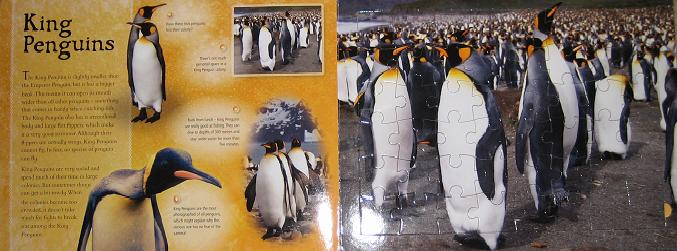
The illustralion which closes this post shows one of the two-page spreads in the Penguins' Jigsaw Book (ISBN 978-1-74211-650-1), which we bought at an Australia Post shop recently for $9.99. The hard-cover book has five different 48-piece jigsaws, each with a bit of interesting information about one of five different kinds of penguins. (There were other books with different subjects, too.) Each of these puzzles is just enough of a challenge to give A a bit of practice with shapes and orientation – a kind of spatial awareness exercise which we think is useful to him.
Blue Care sends us a carer every Thursday for four hours, and it's a great help to both of us. But as was the case with hospital nurses, the health management folk who do these rosters seem to think it's best not to be consistent in their staff assignments. No doubt the aim is to prevent 'clients' getting too attached to individual nurses or carers, and in the Intensive Care ward where A was nearly comatose for so long this policy didn't have too many negative consequences. At least I could look forward to having the 'best' nurses caring for A as often as the less inspiring ones (and while I'm sure they were all well qualified, at least to me some made more interesting companions for the day than others; more importantly, when he was lucid A could understand some of them and not others, and only a few of them could understand his very slurry early speech attempts).
Now that A is able to function so much better, it's unfortunate for him and inconvenient for me that, just as a matter of Blue Care policy, we get different carers from time to time. 'Unfortunate' because it takes time for anyone to get used to A's communication style. And it takes him quite a bit of time to be comfortable enough with a new person to communicate at his optimum level. Then, I need to spend time explaining to every new person things about A and about the house. And each new carer seems to feel the need to read A's entire Blue Care file (which is getting pretty thick). But most importantly, A gets along so well with S (our favourite carer) and so looks forward to the hours he spends with her. So it's a shame when suddenly we get sent a different person, especially one whose communication skills leave a lot to be desired. S and A have a number of favourite activities – she's happy to help him with his puzzles and games, or help him bake a cake, or take a spin around the garden with him. But she also knows just how much to help, and how much to encourage him in his independence. Most of all, she likes conversation and encourages A in his speaking and writing activities. And his communication practice really benefits when he relates so well to his carer. All of the four carers we've had to date have been good, competent professionals, I 'm sure. But S just suits A so well. It's a shame we can't be sure of always getting her. I tried having a discrete word to Blue Care about our preferences, and that seemed to go down OK. So we'll see what happens in subsequent weeks.
The illustralion which closes this post shows one of the two-page spreads in the Penguins' Jigsaw Book (ISBN 978-1-74211-650-1), which we bought at an Australia Post shop recently for $9.99. The hard-cover book has five different 48-piece jigsaws, each with a bit of interesting information about one of five different kinds of penguins. (There were other books with different subjects, too.) Each of these puzzles is just enough of a challenge to give A a bit of practice with shapes and orientation – a kind of spatial awareness exercise which we think is useful to him.
22 October 2009
How can you help Allen?
There are very few people who have the same type of aphasia that Allen has – primary progressive aphasia. Only one of the other participants in this group also has PPA (unfortunately, she was away on a trip when the photo was taken). Other members of the group acquired aphasia as a result of strokes or injuries. But they all experience similar kinds of challenges in their daily lives.
As one of the activities during this clinic, participants developed a 'personal portfolio' containing highlights of their life and information about their family. On one page of the portfolio, there is some advice for family and friends about the best way to communicate with a person who has aphasia. Here is an excerpt from that page in Allen's portfolio:
• Allow me extra time to talk. Let me complete what I am trying to say before you jump in. Please be patient.
• If you can't understand me, encourage me to try another method – e.g. writing my message, pointing to an object or picture, or making gestures to help you to understand.
• Always look at my lips and face, to get additional visual information.
• Don’t be surprised if I speak slowly and exaggerate sounds.
• If you are unsure of what I am trying to say, repeat the information back to me so I can confirm that you have understood me correctly.
• Remember that I am an adult with a speech disorder, and not a child or a person with a mental disorder. Be respectful. You don’t have to exaggerate your speech and you don’t need to talk loudly. I can understand if you speak in a clear, ordinary voice.
• It’s a help if we have our conversation in a place with no other distractions and background noise.
• Always present a positive attitude.
* The Aphasia Clinic is a program offered by the Communication Disability Centre (Division of Speech Pathology, School of Health and Rehabilitation Sciences, University of Queensland). Each week, clinic participants receive one hour of individualised speech therapy developed and delivered by a fourth-year speech therapy student working under the supervision of a Senior Lecturer from the Division of Speech Pathology. Participants and their carers then take part in a one-hour group-therapy session. The clinics meet during the university's two semester session times.
11 October 2009
Down in the vegie patch*
After a slow start to clear away a winter's worth of weeds, one half of my vegie patch is finally underway. It should be more advanced by now, but this season there have been a few goings-on (sic) that have kept me occupied indoors a bit more than usual. (Is that an appropriate use of sic? Not sure.)
I started this year with the potted things – well, styrofoamed things! I have a corner that gets a bit soggy after big rains, so I place some some old fruit boxes there, lifting the plants' roots up a bit to prevent 'wet feet'. Seems to work, but I can only grow certain things in that limited root-space. And while it's still dry I need to check these boxes frequently to make sure the plants don't dry out. At the moment there's a fine crop of basil coming on, and some rocket which is trying to run to seed earlier than I'd like. I keep snipping off the flowers and picking more leaves for the tasty greek salads we're having with nearly every meal. But I had better get another batch of rocket underway elsewhere because I don't think I can hold on to this lot much longer.
I have two kinds of tomatoes coming along nicely. The majority of plants were given to me by my daughter's father-in-law. He grew them from seed and I think they're little Tom Thumbs or some such. I also bought a punnet of six different old-fashioned sorts, just to see what these will produce (if they produce)! Each year I have trouble keeping my tomatoes safe from fruit bats – at least I think they're fruit bats. Whatever they are, they eat out the main part of every tomato and just leave an empty bell hanging. And since the best part of growing tomatoes is being able to have vine-ripened fruit, I don't like picking them too soon. So last year I used fruit-tree netting over each bamboo trellis. And while this worked, it did make picking the fruit and weeding around the plant a bit tiresome. I'm also wary of using netting in the garden since that python got tangled in one net. But unless I net, I have to share the crop with drop-in visitors.
![]()
If you look closely at the tomato photos, you will see that this year I've had to use string to reinforce the joints of my bamboo 'tomato towers'. Most of these structures are now several years old and ought to have been replaced this year. But I don't think A is going to be able to make any more of these so I'm trying to extend the life of those I've got. Some like the one pictured in a more sheltered area of the garden, have a longer lifespan. But in the vegetable patch, where the bamboo is subjected to lots of watering, the towers disintegrate in a couple of seasons. Those I'm using this year are in their third and probably last year of use. (That photo of Allen was taken in March 2007, when he had just completed the first of our current batch of tomato towers. The marigolds were supposed to be companion plants for the tomatoes, but in fact I planted them mainly for the pleasure they would give me while I weeded the vegies.)
This year I have a few 'blow-ins' too – well, not exactly blow-ins, but plants that either self-seeded from last year's crop or that sprung up from compost. The little jap pumpkin is the first fruit showing on a good number of pumpkin plants that either self-seeded, or are on two-year old plants. I'm unsure how some of these plants came to be, but ever since I planted the first pumpkin seedlings more than a year ago I've had pumpkin plants running over various parts of the garden. Some, like the one shown below, which is growing over an old chair, are in areas of the garden that are quite far away from where I originally planted pumpkins. One of last year's vines crawled up the hill there, but then seems to have taken root. Do pumpkin plants reproduce this way? I'm waiting to see if any of the flowers on that plant actually set fruit. But even if the plant doesn't fruit, I rather like the way it has colonised that old chair which hides one of my compost bins, so I'll probably let it go.
A number of young pawpaws (or papayas) have also climbed up out of a section of garden that hasn't yet been weeded and prepared for replanting. They could only come from seeds in last year's compost because I haven't yet got any fruiting pawpaws in the garden (one planted not long ago by friend L when she visited is still very young, and I'm about to plant a red pawpaw near that pumpkin-on-chair). I'll wait and decide what to do with these new ones when I finally weed that bed later this week. They'll probably have to move, though I may leave one in place to see how it goes.
As you can see in all these photos, this year I'm using bales of straw as my main garden mulch – except down in the paddock, where I hope to get some sugar cane rolls delivered this week, to use around the weeping lilly pillys and other natives I planted during the winter. I would like to have something more substantial as mulch, but it's just too difficult to cart heavy loads around to all the different garden levels. Straw is fine, and does break down quickly to help feed the soil. But it has to be renewed often. Still, now that I've managed to learn how to reverse my trailer into even tricky spots, it's easy enough to get another six bales of straw down to the vegetable garden without any back-breaking labor.
Speaking of which, a whole trailerload of rich composty soil and a dozen little boulders are waiting right now to be unloaded. I plan to use all of that to build a more interesting strip of garden around the front edge of the inground water tank, where I think I'll plant herbs instead of the rather dreary little plants I've had there for several years. Now that the new balustrade and pergola have been built around the rear half of this tank, I need something more interesting in the foreground. And it would be a lot easier, when I realise I forgot to pick the herbs for my evening cooking, if I didn't have to take a torch and walk down a flight of stairs to the vegetable garden after dark. Allen and I once tumbled hand-in-hand down those stairs last year, trying to do just that. Being able to take just a few steps off the back verandah instead would be much safer.
Oh, and what else got planted this week? Half a dozen eggplant seedlings, four zucchini plants, a punnet of snow peas (a little late, these, but they're doing well) and some silver beet. Heaps of parsley is well advanced, of course, and four strawberry plants I put in a few weeks ago as an experiment have just begun flowering – these, too, are a bit late for this climate and I've never tried to grow strawberries before, so I don't know how they'll do.
When I get the other half of the vegetable garden weeded, I will squeeze in a few flowers, too. The vegetable patch, which is regularly watered, is the only safe place to grow flowers in my garden. So I always fit in some colour down there – and also in a few pots placed nearby enough to take advantage of the watering regimen. Petunias and lobelias are doing well already, in pots under the macadamia tree at one end of the vegetable garden. The tree gives them – and me, when I need to take a break – a bit of protection from the fierce midday sun. Oh, and that hippeastrum is not near the vegetable garden at all, but I couldn't resist including it in this post. I totally forgot my friend K had planted some of these bulbs along the edges of an ugly clay bank at one side of my studio. At the same time I planted a good ground-covering grevillea nearby and that has now totally covered the bank with its saw-toothed leaves and, for much of the year, red toothbrush-type flowers. So I forgot about the hippeastrum plants. But more than two years later, A and I were walking down past this spot for his daily exercise, and lo and behold: one hippeastrum has suddenly thrust up through the ground cover these four magnificent trumpets! Now I'm waiting to see if others will follow. These little surprises are the best part of having a large garden that you can't always stay on top of (or so I rationalise)!
* Postscript: Once you settle on a dictionary, you really must stick with it. If you start making exceptions, there's no telling where you'll end up. Hence, I use 'vegie' with one 'g', because that's what the online Macquarie says, and Macquarie is my choice! Even a 'fuzzy search' of 'veggie' takes you back to 'vegie', without any alternative spelling being offered. I know you'll find a lot more 'veggies' on the web and elsewhere than 'vegies'. But please: no comments about my spelling. I'd like to use 'veggie'. Really I would. It looks more like what the word sounds like. But the habits of an editor's lifetime just die too hard.
I started this year with the potted things – well, styrofoamed things! I have a corner that gets a bit soggy after big rains, so I place some some old fruit boxes there, lifting the plants' roots up a bit to prevent 'wet feet'. Seems to work, but I can only grow certain things in that limited root-space. And while it's still dry I need to check these boxes frequently to make sure the plants don't dry out. At the moment there's a fine crop of basil coming on, and some rocket which is trying to run to seed earlier than I'd like. I keep snipping off the flowers and picking more leaves for the tasty greek salads we're having with nearly every meal. But I had better get another batch of rocket underway elsewhere because I don't think I can hold on to this lot much longer.
A number of young pawpaws (or papayas) have also climbed up out of a section of garden that hasn't yet been weeded and prepared for replanting. They could only come from seeds in last year's compost because I haven't yet got any fruiting pawpaws in the garden (one planted not long ago by friend L when she visited is still very young, and I'm about to plant a red pawpaw near that pumpkin-on-chair). I'll wait and decide what to do with these new ones when I finally weed that bed later this week. They'll probably have to move, though I may leave one in place to see how it goes.
As you can see in all these photos, this year I'm using bales of straw as my main garden mulch – except down in the paddock, where I hope to get some sugar cane rolls delivered this week, to use around the weeping lilly pillys and other natives I planted during the winter. I would like to have something more substantial as mulch, but it's just too difficult to cart heavy loads around to all the different garden levels. Straw is fine, and does break down quickly to help feed the soil. But it has to be renewed often. Still, now that I've managed to learn how to reverse my trailer into even tricky spots, it's easy enough to get another six bales of straw down to the vegetable garden without any back-breaking labor.
Speaking of which, a whole trailerload of rich composty soil and a dozen little boulders are waiting right now to be unloaded. I plan to use all of that to build a more interesting strip of garden around the front edge of the inground water tank, where I think I'll plant herbs instead of the rather dreary little plants I've had there for several years. Now that the new balustrade and pergola have been built around the rear half of this tank, I need something more interesting in the foreground. And it would be a lot easier, when I realise I forgot to pick the herbs for my evening cooking, if I didn't have to take a torch and walk down a flight of stairs to the vegetable garden after dark. Allen and I once tumbled hand-in-hand down those stairs last year, trying to do just that. Being able to take just a few steps off the back verandah instead would be much safer.
Oh, and what else got planted this week? Half a dozen eggplant seedlings, four zucchini plants, a punnet of snow peas (a little late, these, but they're doing well) and some silver beet. Heaps of parsley is well advanced, of course, and four strawberry plants I put in a few weeks ago as an experiment have just begun flowering – these, too, are a bit late for this climate and I've never tried to grow strawberries before, so I don't know how they'll do.
* Postscript: Once you settle on a dictionary, you really must stick with it. If you start making exceptions, there's no telling where you'll end up. Hence, I use 'vegie' with one 'g', because that's what the online Macquarie says, and Macquarie is my choice! Even a 'fuzzy search' of 'veggie' takes you back to 'vegie', without any alternative spelling being offered. I know you'll find a lot more 'veggies' on the web and elsewhere than 'vegies'. But please: no comments about my spelling. I'd like to use 'veggie'. Really I would. It looks more like what the word sounds like. But the habits of an editor's lifetime just die too hard.
10 October 2009
It must be Spring
27 September 2009
Shitty news this week!
This post is a jumble, just to get me back in the swing. Lots has been happening around here since I last visited...some good things (e.g. J's wedding which I'll talk about elsewhere), and some (e.g. septic problems) not so good. The problems are gradually righting themselves, with quite a lot of help from me and various tradesmen (no fewer than five different sets of contractors got stuck into the sewerage problem – some literally so!) First, a plumber 'looked into' the problem. Next, a couple of incredibly cheerful young men pumped out the holding tank. And I was reminded what a pleasure it is (and how unusual) to find young adult male strangers who are not only polite, but actually friendly to a couple of old wrinklies like us. A's Blue Care carer was still here when these boys arrived. One of the guys had had a bad motorbike accident a few years ago. During his recovery Blue Care nurses had helped him a lot, and he was particularly keen to express his appreciation of that. Maybe that early brush with near-death left a big impression, but for whatever reason he really was an unusually happy-go-lucky young man, given the rather unpleasant nature of his work.
Remembering this week's contacts with tradespeople reminds me: I must ask the library to find a copy of Shop Class as Soulcraft: An Inquiry Into the Value of Work, by Matthew B Crawford. It's reviewed in this week's Weekend Australian, and sounds tantalising. "Crawford's aim is to extol the worth of skilled labour, the practice of a trade....The work they [tradesmen] do requires 'practical wisdom'....Above all, their work genuinely benefits society because it produces tangible, readily assessable results." How many of us public servants have occasionally been tempted to throw in careers in "the most ghostly kinds of work", by which Crawford means "phony, ill-defined, ephemeral" work! How many have thought, sometimes very seriously, about tossing it all in and retraining in something like landscape gardening or cooking! I certainly have. At such times, we probably felt we were doing what reviewer Roy Williams in this article describes as "jobs that don't require doing anything extremely well", in what author Crawford calls 'the world of white-collar bullshit". Coincidentally, last night I began reading Adrift on the Nile by Naguib Mahfouz and in the first paragraph I came across this: "On the shelves the files enjoy an easeful death. How diverting they must find the civil servant at work, carrying out, with utterly serious mien, utterly trivial tasks." I was immediately propelled back in time into my literally and figuratively grey office at Education Queensland.
of this particular feeder tray a part of their daily menu. I had to move the bird feeders off to either side of the water tank because of the work going on to build a new balustrade. But now I've decided to keep the feeders there, among the bushes and trees, so visitors' droppings are less likely to mess up our lovely new cypress timberwork. And so this post ends where it began – with waste management.
12 September 2009
Lucy's weekend
The kiddos are here for the weekend. These particular kiddos include Z, one of our three, plus new hubby B, hereafter to be known as the Z/B+L team. 'L' is for 'Lucy', their 4-yr-old Jack Russell, who goes everywhere with them. Well, not quite everywhere. Right now she's lying on the bed in the guest room, probably counting the minutes until Mama and Papa's return from a shopping trip.
L is as close to human as a canine can get – which is very close indeed. She doesn't seem to appreciate that there's any significant difference in nature between herself and her beloved foster parents. She can't quite run their lives as much as she would like, else they'd never go away and leave her, even for a minute. But she does command a good deal of their attention and affection when they are together, even if it's clear to her that she's not top dog. This seems to suit her temperament. Even though she is obviously fiercely loyal to her immediate family, she still displays a loving and trustful nature toward us, probably recognising we are somehow related, part of her extended 'pack'.

A ratter by pedigree, L makes a beeline for certain spots at our place as soon as she arrives. A particular rock alongside the stairs leading down to the pool is one favourite spot. A collection of rocks at the base of one of our bird feeders is another. Lizards and toads probably hide in the spaces behind these rocks – or maybe even the odd snake (god forbid). L would like very much for me to move all of these rocks as soon as she gets here, to give her access to whatever it is that her sensitive nose tells her is worth digging out.
On this visit, she's selected another spot – this one indoors, in A's little office, where she has rarely bothered to venture on past visits. Years ago, the area behind the desk and an adjacent large cupboard in this converted verandah space were known hiding places and getaway routes for a family of mice. Once, too, a little tommy roundhead dragon lived behind and around the tall cupboard for many weeks. This lizard seemed to have got himself marooned there. He probably snuck in when the screen door was ajar for some reason. I never liked leaving the door open too long because years earlier, we had found a ground snake of indeterminate species curled up on the floor in that little room. My good neighbour, D, managed to shoo that one outside, using only a long-handled broom. His calm sweeping of the snake in the direction of the exit door was not much helped by my excited yelping from the safety of a nearby bedroom. (We hadn't lived here long and I wasn't yet acclimatised to the local wildlife. Later I became more laid back about little emergencies of this kind, one of which I have described in Drop-in visitors: The legless variety.) After that first snake incident, we found a small hole at the point where the cement floor of the former verandah met the house's own cement slab. So that entry point was long since blocked off when the little dragon suddenly appeared. And since we couldn't manage to extricate him, we resorted to feeding him instead. Every evening I would leave a small saucer of water out on top of the cabinet, and a little knob of beef mince which was always gone in the morning. We would occasionally see the dragon clinging to the roughly-hewn cedar weatherboards that lined the wall behind the cupboard. But eventually, he must have found a way out, for the knobs of mince were no longer taken and we stopped seeing him.
Since the nobby dragon moved on, the cement floor in the room has been tiled. The cedar weatherboards sanded and the whole room given two coats of paint. And we have not seen another mouse, lizard or snake in the room for years. I did find a whole colony of black ants, complete with eggs, packed tightly into A's printer in there – this toward the end of the several months we spent away from home while A was in hospital. On this occasion, I'd come home for a quick overnight visit to collect some paperwork, and went into the office to use the printer to photocopy something. On lifting the printer lid, I got a terrible shock to see a fully functional ant colony jam-packed under the glass. Lacking the energy it would take to clean up such a mess at that harrowing time, I bundled the inexpensive printer and its resident ant farm into a trash bag and dumped the lot into the bin on my way out the gate.
L is as close to human as a canine can get – which is very close indeed. She doesn't seem to appreciate that there's any significant difference in nature between herself and her beloved foster parents. She can't quite run their lives as much as she would like, else they'd never go away and leave her, even for a minute. But she does command a good deal of their attention and affection when they are together, even if it's clear to her that she's not top dog. This seems to suit her temperament. Even though she is obviously fiercely loyal to her immediate family, she still displays a loving and trustful nature toward us, probably recognising we are somehow related, part of her extended 'pack'.
Since the nobby dragon moved on, the cement floor in the room has been tiled. The cedar weatherboards sanded and the whole room given two coats of paint. And we have not seen another mouse, lizard or snake in the room for years. I did find a whole colony of black ants, complete with eggs, packed tightly into A's printer in there – this toward the end of the several months we spent away from home while A was in hospital. On this occasion, I'd come home for a quick overnight visit to collect some paperwork, and went into the office to use the printer to photocopy something. On lifting the printer lid, I got a terrible shock to see a fully functional ant colony jam-packed under the glass. Lacking the energy it would take to clean up such a mess at that harrowing time, I bundled the inexpensive printer and its resident ant farm into a trash bag and dumped the lot into the bin on my way out the gate.
Could L still be sniffing one or more of those former residents? Mice, lizard and snake all predated the sanding, sealing and painting. Even the big old cupboard has been sanded down and refinished since then. Could L's nose be that sensitive? Or must I face the fact that there is, yet again, something living behind that cupboard. The question is: Do I want to know what?
05 September 2009
Clean water for the house
It's time to chlorinate the rainwater again. We use this water for all indoor purposes except to fill the toilet cistern, which is fed from a different holding tank that contains dam water. We decided years ago we would treat our rainwater with sodium hypochlorite from time to time. That was after we took a water sample to the local Council's health lab for testing. We'd been suspicious that the water may have been a bit 'tainted', and the lab results confirmed that at that time our rainwater contained some unpleasant bugs. With possum racing around the roof on most nights, a couple of ducks who regularly land on the roof before hopping down to the pool and bats flying overhead regularly, the house's gutters inevitably end up containing a few unpleasant souvenirs of these otherwise welcome visitors. So we feel our drinking water should be purified regularly. Water filters that can eliminate bacteria are very expensive and need to be changed frequently. And cleaning the gutters is a big job that we can't do often enough to ensure a pristine water supply. Chlorinating the tank water is the best solution to this problem, we think.
So about once in each season, we begin by checking the volume of water remaining in our 40,000 litre concrete holding tank. Then we add the correct amount of liquid sodium hypochlorite to kill any bugs. We obtained information from our Council about the appropriate amount to add per 1000 litres; you should check for yourself what your council's health officers advise. Then you have to know the formula for working out the volume of a cylinder (V = πr2h). Mathematical calculations are a problem for anyone with aphasia, so Allen's happy to leave this part of the job to me. Even so, I need to look up the formula every time we do it! Allen keeps a long piece of bamboo for measuring the 'height' of water in the tank; the radius, of course, remains constant. So, using the radius and height-of-water data, we calculate the volume of water remaining. After that it's a simple matter of mixing
the correct amount of sodium hypochlorite into a pailful of tap water, adding that to the tank and using the bamboo pole to mix it in and splash around the water in the tank. Not long after we finish this task, we will detect a faint odour of chlorine when turning on house taps or having a shower. It's no more than you would have in city water, of course, but here in the hinterland we notice it right away. That's why we also installed a chlorine-filtering water fountain on one side of the kitchen sink, so we never need to 'taste' chlorine in our drinking water. The chlorine smell soon dissipates. Anyway, a temporary odour is a small price to pay to know that any traces of animal faeces that may have washed into the water supply aren't going to give visitors diarrhea or stomach upsets.
Postscript: In March 2010, a tank and water expert inspecting our tank informed me we should NOT be using sodium hypochlorite in a concrete tank, for a bunch of reasons he enumerated. And we should NOT boil our rainwater before drinking, because of the bad effect this can have on any gum leaf residue that may be in the water! (What about making tea, I ask! Get a product called 'Aqua-flo', he said, if you must do anything. Best of all, just keep the tank clean. Easy for him to say, when the only way to clean a 10,000 gallon tank is to first empty it out. Our water level hasn't fallen below half since we stopped using that water on the garden and got access to dam water for that purpose. Not easy to throw away 5000 gallons of good rainwater just for the sake of a spring clean.
So about once in each season, we begin by checking the volume of water remaining in our 40,000 litre concrete holding tank. Then we add the correct amount of liquid sodium hypochlorite to kill any bugs. We obtained information from our Council about the appropriate amount to add per 1000 litres; you should check for yourself what your council's health officers advise. Then you have to know the formula for working out the volume of a cylinder (V = πr2h). Mathematical calculations are a problem for anyone with aphasia, so Allen's happy to leave this part of the job to me. Even so, I need to look up the formula every time we do it! Allen keeps a long piece of bamboo for measuring the 'height' of water in the tank; the radius, of course, remains constant. So, using the radius and height-of-water data, we calculate the volume of water remaining. After that it's a simple matter of mixing
Postscript: In March 2010, a tank and water expert inspecting our tank informed me we should NOT be using sodium hypochlorite in a concrete tank, for a bunch of reasons he enumerated. And we should NOT boil our rainwater before drinking, because of the bad effect this can have on any gum leaf residue that may be in the water! (What about making tea, I ask! Get a product called 'Aqua-flo', he said, if you must do anything. Best of all, just keep the tank clean. Easy for him to say, when the only way to clean a 10,000 gallon tank is to first empty it out. Our water level hasn't fallen below half since we stopped using that water on the garden and got access to dam water for that purpose. Not easy to throw away 5000 gallons of good rainwater just for the sake of a spring clean.
04 September 2009
Sharing the load
Today I was able to get A down into the 'paddock' (the poor quality of grass growing there hardly merits calling it a 'lawn'). This is the first time since he came home from hospital two months ago that A's been down to the bottom of the block. There's just no easy way to get him down there that doesn't involve too many steps or walking on reasonably steep and slippery grass. So until now he and his walker have been confined mainly to the garden around the house.
I did 'walk' him down half a dozen steps earlier this week to the middle level of the block, where our fruit trees are growing. This was so he could join me in picking the first mulberries of the season
, always a happy occasion and especially so this year as the tree has grown a lot and is fruiting very well. My recent landscaping in that area (levelling out a narrow terrace and creating a path near the pump house) plus heavy summer mulching of adjacent garden areas must be providing more favourable conditions down there, because as well as a lot of growth for this tree and a big crop of mulberries, we also had monster grapefruit and dozens of juicy oranges on two other nearby trees that had never been very prolific in past years. Now I'm hoping that this run of luck will extend to a good crop of mangoes. My four mango trees are a mass of flowers right now but it's too soon to tell if these will fruit as well as they're flowering. The ground begins to slope down toward the dam under all of these fruit trees, including the mulberry, and several times I thought I might lose A or his walker, as he tottered dangerously in the direction of the slope while reaching up for another handful of berries. So today I thought we'd play it safe and drive down in the Subaru, but not to pick berries (I already have plenty in the fridge so I'm letting the figbirds have a go). Today I had a more utilitarian purpose in mind – as well as a therapeutic one.
For almost two weeks now my trailer and its heavy load of clay pavers has been blocking up the driveway's small turning circle. The pavers are a donation from daughter Z & son-in-law B, who had a large stock of these new pavers left over from another job. I am bringing these from their Brisbane home back to our place in several stages on Mondays. This is the day each week when we travel to Brisbane for A's weekly Aphasia Clinic at the University of Queensland. On the way home from clinic, we collect another load of pavers. Once I have the right amount, the fellow who has mown and trimmed our paddock for nearly 15 years is going to lay a new path from the stairway that leads down from the front terrace of the house, over to the pool entrance gate. The current path was made of an inferior type of sleeper and over the years these have rotted. Today my plan was to unload the first batch of pavers somewhere down near the path site so that the trailer is ready for our next trip to Brisbane on Monday.
There isn't much that A can do to help in this job, as he really hasn't sufficient strength to lift and carry pavers or enough balance to walk safely over the rough surface of the paddock, where I'll be unloading and stacking them. But if he rides along with me he can at least feel he's part of the day's activity – plus get a look at the dam and lower paddock for the first time in more than six months. (Even before his operation in March, He hadn't been able to get down there for some time and certainly hasn't been able to since coming home). But there's another reason I especially want him to feel involved today.
Yesterday, I was unloading the first few pavers and stacking these on the topmost terrace, right outside the house. This was to lighten the trailer sufficiently so that I could turn it around manually in the driveway, face it in the right direction and hook it up again to the car, ready for me to drive it down to the lower garden level today and offload the rest of the pavers nearer the path site. I looked up while stacking these first few pavers on the terrace, and there was A standing right next to me. He had come out onto the terrace with his walker and was watching me work. And he was crying. I immediately thought perhaps he'd had a fall or hurt himself in some way. But when I asked what the matter was, he said: "You shouldn't be working like that."
A has always been very active around the house, doing all sorts of odd jobs and putting to good use a lifetime of building and problem-solving skills acquired while he worked behind the scenes in theatres all over Australia and New Zealand. When we lived in Tasmania, with the help of a friend he converted an old garden shed into a lovely little studio which he used as his writing workspace (he was writing ABC education scripts for radio and television at the time). He repainted our Hobart house and then restructured two rooms of the house to make one larger one. Once, after he made some shelves for my then-single sister, I remember how jealous she was that I had all those skills permanently 'on tap'. One of my favourite photos from Hobart is of A perched atop the roof of that Hobart studio, leather apron full of tools, busily getting on with repairing the roof. Our kitchen windows in the Hobart house overlooked a narrow side path that offered the only access to a small back garden. On any weekend day when I was standing at that window, washing up or preparing a meal, I could expect to see A's head bobbing along as he went up and down the path – carrying tools and materials for his latest backyard project – some oregon pine for a pergola, sandstone paving for a little courtyard, old pine lining from a recycle yard for the interior walls of his studio.
When we moved to Brisbane, A's handiwork continued unabated. He fitted endless sets of shelves into the many nooks and crannies in our old 'Queenslander' style house, rejoicing in the fact that every wall and ceiling was made of wood, so drilling in a screw never resulted in the cracks that would sometimes be the outcome of drilling into the plaster in our 100-year-old brick house in Hobart. Yes, he was always a terrific handyman. So it didn't surprise me that he felt bad about not being involved in today's backyard project. But I should have been even more ready for that reaction after something he said earlier in the week that really did surprise me.
A few days ago, A and I were having a quietly reflective conversation about his recent health problems and his longer-term battle with aphasia, a condition first diagnosed more than three years ago. I asked him what part of his 'illness' he found most difficult to deal with. His answer surprised me. He said what he regretted most was the his inability TO DO THINGS. He went on to explain that he hates not being able to just get up and do whatever needs to be done, or what he wants to do – in other words, his biggest regret is his loss of physical dexterity. That surprised me because I suppose what I value most in my husband (and, I guess, miss most) were things like the expression of a keen intelligence, a lively wit, the ability to recall the names and contents of books and movies, a wide general knowledge and the ability to make connections between new information and old experiences – in short, mental adroitness. I would have expected A, too, to regret most the impairment of all these mental faculties – not to mention speech and the general ability to
communicate easily – much, much more than the inability to just get up and 'do things'. And of course, he does regreat losses in all those areas, and worries what further losses may lie ahead. But our conversation reminded me that as well as focusing on therapies intended to help maintain a high quality of mental activity, we must also make sure that A continues to feel part of each day's physical activity around the place, no matter how much (or little) he an actually do of the work involved.
So today, instead of barrelling along on my own to complete a set of planned tasks on a day set aside for just that, I made sure to include A in the day's activity. Really, it was much simpler than I had expected. Indeed, it made the job seem easier, even if all A could contribute was good company and a bit of advice. (I had no fear he'd be anything but willing as, just before he went to hospital, he very patiently taught me how to operate a new cordless drill we bought. And then quietly talked me through the installation of my own first set of bookshelves!) Today's work didn't take much longer than it might have if I'd done it on my own. What's even better, I didn't notice the time it took because we stopped often to talk about this and that. And as he was with me the whole time, I didn't have to worry all afternoon about whether or not I'd hear him calling to me from the house if he needed me.
When I had finished unloading the pavers from the trailer, I was able to cart down to the bonfire site a number of trailerloads of dead palm fronds and heaps of discarded pandanus 'leaves', neither of which breaks down very successfully in compost. So as soon as the fire bans are lifted, we can look
forward to a lovely evening of slow burn-off down there, with a couple of beers, the setting sun and the glow from a slow fire. Later I'll plant more Australian natives in those burned areas of grass.
Not a bad (joint) effort for a Friday!
I did 'walk' him down half a dozen steps earlier this week to the middle level of the block, where our fruit trees are growing. This was so he could join me in picking the first mulberries of the season
For almost two weeks now my trailer and its heavy load of clay pavers has been blocking up the driveway's small turning circle. The pavers are a donation from daughter Z & son-in-law B, who had a large stock of these new pavers left over from another job. I am bringing these from their Brisbane home back to our place in several stages on Mondays. This is the day each week when we travel to Brisbane for A's weekly Aphasia Clinic at the University of Queensland. On the way home from clinic, we collect another load of pavers. Once I have the right amount, the fellow who has mown and trimmed our paddock for nearly 15 years is going to lay a new path from the stairway that leads down from the front terrace of the house, over to the pool entrance gate. The current path was made of an inferior type of sleeper and over the years these have rotted. Today my plan was to unload the first batch of pavers somewhere down near the path site so that the trailer is ready for our next trip to Brisbane on Monday.
Yesterday, I was unloading the first few pavers and stacking these on the topmost terrace, right outside the house. This was to lighten the trailer sufficiently so that I could turn it around manually in the driveway, face it in the right direction and hook it up again to the car, ready for me to drive it down to the lower garden level today and offload the rest of the pavers nearer the path site. I looked up while stacking these first few pavers on the terrace, and there was A standing right next to me. He had come out onto the terrace with his walker and was watching me work. And he was crying. I immediately thought perhaps he'd had a fall or hurt himself in some way. But when I asked what the matter was, he said: "You shouldn't be working like that."
A has always been very active around the house, doing all sorts of odd jobs and putting to good use a lifetime of building and problem-solving skills acquired while he worked behind the scenes in theatres all over Australia and New Zealand. When we lived in Tasmania, with the help of a friend he converted an old garden shed into a lovely little studio which he used as his writing workspace (he was writing ABC education scripts for radio and television at the time). He repainted our Hobart house and then restructured two rooms of the house to make one larger one. Once, after he made some shelves for my then-single sister, I remember how jealous she was that I had all those skills permanently 'on tap'. One of my favourite photos from Hobart is of A perched atop the roof of that Hobart studio, leather apron full of tools, busily getting on with repairing the roof. Our kitchen windows in the Hobart house overlooked a narrow side path that offered the only access to a small back garden. On any weekend day when I was standing at that window, washing up or preparing a meal, I could expect to see A's head bobbing along as he went up and down the path – carrying tools and materials for his latest backyard project – some oregon pine for a pergola, sandstone paving for a little courtyard, old pine lining from a recycle yard for the interior walls of his studio.
When we moved to Brisbane, A's handiwork continued unabated. He fitted endless sets of shelves into the many nooks and crannies in our old 'Queenslander' style house, rejoicing in the fact that every wall and ceiling was made of wood, so drilling in a screw never resulted in the cracks that would sometimes be the outcome of drilling into the plaster in our 100-year-old brick house in Hobart. Yes, he was always a terrific handyman. So it didn't surprise me that he felt bad about not being involved in today's backyard project. But I should have been even more ready for that reaction after something he said earlier in the week that really did surprise me.
A few days ago, A and I were having a quietly reflective conversation about his recent health problems and his longer-term battle with aphasia, a condition first diagnosed more than three years ago. I asked him what part of his 'illness' he found most difficult to deal with. His answer surprised me. He said what he regretted most was the his inability TO DO THINGS. He went on to explain that he hates not being able to just get up and do whatever needs to be done, or what he wants to do – in other words, his biggest regret is his loss of physical dexterity. That surprised me because I suppose what I value most in my husband (and, I guess, miss most) were things like the expression of a keen intelligence, a lively wit, the ability to recall the names and contents of books and movies, a wide general knowledge and the ability to make connections between new information and old experiences – in short, mental adroitness. I would have expected A, too, to regret most the impairment of all these mental faculties – not to mention speech and the general ability to
When I had finished unloading the pavers from the trailer, I was able to cart down to the bonfire site a number of trailerloads of dead palm fronds and heaps of discarded pandanus 'leaves', neither of which breaks down very successfully in compost. So as soon as the fire bans are lifted, we can look
Not a bad (joint) effort for a Friday!
01 September 2009
Drop-in visitors: The legless variety
My best ally in the battle to keep mice and other rodents a safe distance from my kitchen had to be the majestic carpet python who visited us each winter for years. I like to think that the snake we sighted at least once or twice each winter was one and the same individual, and not a procession of passers-by. But though we have many photos of the python’s arrival and departure over successive years, we don’t have sufficiently similar ‘poses’ to positively identify the markings
Now and then during the winter months in those years, as I lay in bed at night I would imagine I could hear the soft swishing noise of snake moving around up in the roof-space. More likely, however, the python lay quite motionless throughout the cold season, possibly keeping just a bit warmer up there than it would have out in the bush. One thing we definitely did not hear as long as the python was up there was the scratching of rodents scampering about in the ceiling space, as we did used to hear in earlier years, before the python became a winter boarder. But sometimes I would worry that if the snake did find a meal of rat up there before trying to come out at the end of winter, it might well get stuck in that tiny hole. One of the roof’s galvanised iron sections would then have to be lifted to free it. After all, we had experienced the awful stench of a dead rat in the attic and I could just imagine how much worse it would be to have so many kilos
Unfortunately in April 2008 my python (or if not ‘my’ python, then a cousin or close-enough friend to be sharing the same environment) had a nearly fatal accident just outside my studio. And I fear the experience may have given him such a shock that he has abandoned our block as too dangerous a place to hang around. Here’s what happened.
In a shady corner near the entrance to my little studio, I found some frog eggs in a large saucer of water that sits under a big pot plant. I had recently seen a very pretty tree frog near there, so I decided to place a scrunched-up section of bird netting around the saucer, hoping to keep the eggs and then tadpoles safe from cane toads. I thought that maybe some of the froglets might make it to maturity, safe from marauding cane toads and with the added shelter created by the netting. A few days later, as I was coming out of the door from my studio, my eye caught movement over in that corner. I turned to see that the pot plant was lying on its side. Tangled up in the bird netting at its base and thrashing about was a small python. The snake must have been there for some time already because the large mesh of the bird netting was wrapped tightly around the snake’s body in several different places. Only the head and about 30 cm of the python’s body were free of the netting. Everything after that was totally entangled.
As I approached the desperate python lunged at me, but I managed to pick up the snake-and-netting bundle by its tail and drag it clear of the corner, out into the pathway. But this was more than a one-person job, so I rang my neighbour, D.S., an 84-year-old gentleman who goes around the neighbourhood digging up feral weeds in bushland backyards and generally keeping an eye on local fauna and flora. I knew he had ‘transplanted’ a stubborn python who on several occasions had taken up residence in another neighbour’s garage. (Personally, I would been happy to have such a python living in my garage, but this neighbour was a recent
Pythons aren’t poisonous, of course, but they can bite. And that bite can carry infection. Anyway, if we were going to be able to free the snake, we needed to keep it reasonably quiet during the process. D.S. used the handle of his cane to gently immobilise the python’s flailing head, and then grabbed hold of the snake right behind the head. I fetched my sewing shears and, as D.S. held the upper body secure, I located the first piece of netting in which the body was stuck fast. The undulating motion of the snake’s muscles as it continued to try and writhe itself free meant that for just a few seconds, each section of body would contract slightly. And each contraction allowed me just enough slack to slip one blade of the scissors in between the snake’s skin and a strand of bird net.
That, I fear, may well have been the last we will see of a python near the house for quite a while. I like to think the snake appreciated that D.S. and I were being good Samaritans, but I think more likely it filed us and our garden under the heading: ‘People and places to avoid in the future’. How else can we account for the fact that ever since that day in April 2008, even though A and I have spent more time at home and less time travelling than ever before in the 13 years
Postscript: I'll talk about visiting birds in a separate post.

Subscribe to:
Posts (Atom)
About me
- Chartreuse
- Journalist, editor, teacher, publishing manager, education consultant….but that’s all in the past. Even further back, I could add waitress, Five-and-Dime salesgirl and my favourite title: Girl Friday! All mixed in with wife, mother, caregiver and grandmother. But nowadays, based on time spent: gardener, cook, reader, writer and whatever!